If you’re serious about sewing heavy fabrics — denim, canvas, thick upholstery — you already know that a standard machine just won’t cut it. It’ll skip stitches, vibrate like it’s about to fall apart, and sometimes leave that faint burning smell that signals something’s struggling. That’s the moment when a genuinely heavy-duty machine stops being a luxury and starts being the only option that makes sense.
My top pick for most people in this situation is the Brother ST371HD Strong and Tough Sewing Machine. It handles the full spectrum — from delicate silk to stubborn leather — without you having to fight it the whole way. What I appreciate about it isn’t just the durability; it’s the balance. You get a machine that’s tough enough for repair work and dense fabrics, but won’t intimidate you when you’re doing something simple.
That said, it’s not the only solid option out there. Below, I’ve broken down five heavy-duty machines worth your attention — what makes each one work, and where they fall short.
Contents
- 1 What to Actually Look for in a Heavy-Duty Sewing Machine
- 2 5 Heavy-Duty Sewing Machines Worth Considering
- 3 Final Recommendation
What to Actually Look for in a Heavy-Duty Sewing Machine
Before getting into specific models, here’s the thing most buyers overlook: not all “heavy-duty” labels mean the same thing. Some machines are marketed that way but still shake noticeably on thick seams, or bog down mid-stitch when you’re layering denim. A genuinely capable machine tends to show itself in a few specific ways.
The Frame Makes More Difference Than You’d Think
When a machine has a metal frame — real iron or steel, not the reinforced plastic that gets called “sturdy” in product listings — you feel it almost immediately. Less vibration. More consistent stitch tension. The kind of stability that lets you run the machine at higher speeds without it walking across the table.
In practice, a metal chassis tends to mean longer service life and fewer alignment problems over time. If you’re doing hours of continuous sewing, or regularly working through multiple fabric layers, that structural solidity starts to matter a lot more than any stitch pattern menu.
Speed Controls and Fabric Sensitivity
Older machines left all the speed decisions to you. You’d manually adjust based on what the fabric seemed to need — which worked, but it also ate up a surprising amount of mental bandwidth, especially on longer projects.
Modern heavy-duty machines usually include variable speed controllers that do a lot of that adjustment automatically. They read the fabric’s resistance and shift accordingly. It’s not magic, but it does make the process feel more intuitive — like the machine is working with you instead of just responding to your foot pedal.
Stitches Per Minute: The Real Performance Metric
This is where you can actually compare machines objectively. A reliable heavy-duty machine typically produces somewhere between 800 and 1,000 stitches per minute — some of the more powerful computerized models push closer to 1,500 to 2,000. Higher SPM doesn’t just mean faster work; it also means the machine can power through thick layers without stalling or producing uneven tension.
For most home sewists doing repair work, quilting, or garment construction, anything in the 800–1,000 range handles the job well.
Power: More Is Usually Better for Heavy Fabrics
There’s a fairly direct relationship between motor power and how smoothly a machine moves through dense material. A weaker motor technically can get through canvas or thick denim — but it labors doing it, and that kind of sustained strain isn’t great for the machine’s longevity.
For most heavy-duty work, you want a motor that doesn’t have to strain. In practice, this usually shows up as consistent stitch quality across fabric layers without the needle slowing noticeably. If you’re regularly working with upholstery-weight fabrics or multi-layer quilts, it’s one of the more important specs to pay attention to.
5 Heavy-Duty Sewing Machines Worth Considering
1. Brother Strong and Tough Sewing Machine ST371HD


If you want one machine that handles both tough repair jobs and lighter creative projects without requiring constant adjustment, the ST371HD is genuinely hard to beat in this price range.
It comes with 37 built-in stitches — decorative options, blind hem, zigzag, stretch, and reinforcement stitches among them. The drop feed feature opens up free-motion sewing, which is useful for cylindrical pieces and anything requiring more creative control. The metal needle plate holds up better than plastic alternatives over time, and the needle selection is practical: a #16 for canvas or denim, #14 for layered fabrics, #11 for regular or lightweight materials like silk.
Navigating the stitches is simple — a stitch selector dial gives you a visual layout of your options right in front of you. The one-step buttonhole function accommodates your actual buttons rather than forcing you to guess at sizing. The convertible free arm handles sleeve hems, cuffs, and other cylindrical stitching without much fuss, and the spring-action zigzag foot manages thick seam transitions more smoothly than you’d expect.
Standard features — automatic needle threader, top drop-in bobbin, non-stick presser foot — are all there and work reliably. The accessory package is solid too: four bobbins, six feet, twin needle, extra spool pin, three-piece needle set, screwdriver, and a DVD guide with bilingual manual.
Pros
- Stable metal chassis holds up even at higher speeds
- 37 stitches with strong versatility across fabric types
- Heavy-gauge needles handle dense materials without skipping
- Six quick-change feet for different tasks
- Storage compartment keeps accessories organized
- Comes with instructional DVD and technical support access
Cons
- At least one user reported the needle slipping within the first six hours of use
- Some buyers found the included DVD didn’t work on their devices
2. Janome HD1000 Heavy Duty Sewing Machine

Janome has been in the sewing industry long enough that the brand name carries some real weight. The HD1000 lives up to it in most ways — the cast aluminum exterior is genuinely durable, and the machine has that solid, planted feel when you’re running it at higher speeds.
It offers 14 built-in stitches and a 4-step buttonhole function. That’s a narrower stitch selection than the Brother or Singer options on this list, but for people who primarily do home dec work, basic garment construction, or everyday mending, 14 stitches is usually more than enough. The automatic needle threader is a small but genuinely useful convenience. The feed dogs lower for free-motion stitching and quilting. And the removable storage compartment converts the machine into a free arm when you’re working on sleeves, trouser hems, or anything cylindrical.
The 3-piece feed dog system is worth mentioning — it keeps fabric feeding consistently even with high-pile or uneven materials, which is something cheaper machines sometimes struggle with.
It comes with a hard-sided cover included, which you’ll appreciate if you’re storing it somewhere it might collect dust. Stitch length and zigzag width adjust via a conveniently placed dial. Presser feet for zippers, blind hemming, sliding buttonholes, and general-purpose sewing are all in the box.
Pros
- Cast aluminum body offers long-term durability
- 3-piece feed dog system handles a range of fabric textures
- Free arm function adds versatility for fitted garment work
- Automatic needle threader reduces eye strain on detailed work
- Comes with a proper hard-sided cover
- Multiple reviewers noted it’s reliable, fast, and straightforward to operate
Cons
- Several buyers found it on the expensive side relative to features offered
- A few users felt it was best suited to basic mending rather than more complex construction
3. Singer Simple 3232 Portable Heavy Duty Sewing Machine

If you’re earlier in your sewing experience and don’t want to spend a lot of time consulting the manual every five minutes, the Singer 3232 is worth a close look. It’s designed to be approachable without sacrificing too much on capability.
The metal frame provides stability that you don’t always find at this price point — it doesn’t wobble or drift during longer sessions. Speed comes in at roughly 750 stitches per minute, which sits at the lower end of heavy-duty range, but handles most everyday projects without issue.
You get 32 built-in stitches total: 19 decorative, 6 stretch, 6 utility, and a buttonhole. The fully automatic single-step buttonhole is genuinely one-touch, which removes a common source of frustration for beginners. The free arm feature handles pant hems, collars, and cuffs without requiring you to perform any gymnastics with the fabric. Stitch length and width are both adjustable — useful when you’re learning what different settings actually do to your finished seam.
Four snap-on presser feet cover the main use cases. The automatic reverse stitching function reinforces seams without additional steps. The high presser foot lifter accommodates multiple stacked layers, which matters when you’re working with quilted fabric or thick seam allowances. And if you get stuck, there’s a solid library of step-by-step tutorials available online — which, honestly, is more useful than most included DVDs.
The accessory bundle includes needles, lint brush, seam ripper, L-screwdriver, thread spool caps, darning plate, quilting guide, dust cover, and foot control.
Pros
- Heavy-duty metal frame keeps the machine stable during use
- 32 built-in stitches offer good variety for beginners and intermediates
- Automatic needle threader, free arm, and adjustable stitch dimensions included
- High presser foot lifter handles multiple layers smoothly
- Automatic reverse stitching reinforces seams without extra steps
- Online tutorials and customer support available
Cons
- At least one user reported significant dissatisfaction with the customer service experience
- One buyer found the needle threader arrived bent and non-functional
4. Singer Fashion Mate 3333 Free Arm Sewing Machine

The Fashion Mate 3333 takes a slightly different angle — it’s clearly designed with garment construction and visual appeal in mind, not just pure heavy-duty performance. If aesthetics matter to you in a workspace (they do to some people, and that’s a reasonable thing), this machine looks noticeably better than most in its price category.
That said, it’s not just about appearances. The heavy-duty metal frame is real — it gives the machine genuine durability and stability when working through thicker fabrics. Singer’s app and accompanying instructional videos are available for when you need help mid-project, which is a practical touch that not every manufacturer offers.
It has 23 built-in stitches — stretch, decorative, and standard basics — plus a 4-step buttonhole that you can customize to fit specific buttons. The automatic needle threader takes eye strain out of threading sessions. Free arm functionality handles the usual suspects: sleeve hems, collars, cuffs, small repairs. The built-in LED light is more useful than it sounds — if you’re working on dark fabric or in a room with uneven lighting, it noticeably improves visibility at the needle.
Singer backs this machine with a 25-year limited warranty, which gives it a long-term credibility most competitors can’t quite match.
Pros
- Sleek, contemporary design — genuinely looks good in a workspace
- Heavy-duty metal frame for lasting durability and stability
- 23 stitch patterns with customizable buttonhole function
- Singer app and video tutorials provide accessible on-demand support
- Stitch selector dial with flexible stitch length options
- Built-in LED illumination for dark fabrics
- Top drop-in bobbin with clear cover for thread monitoring
- Substantial warranty coverage (25 years, limited)
Cons
- At least one user reported the bobbin frequently slipping off track with limited guidance for fixing it
- One experienced sewist described the machine as more frustrating than expected for extended use
5. Janome MC-6300P Professional Heavy Duty Computerized Sewing Machine
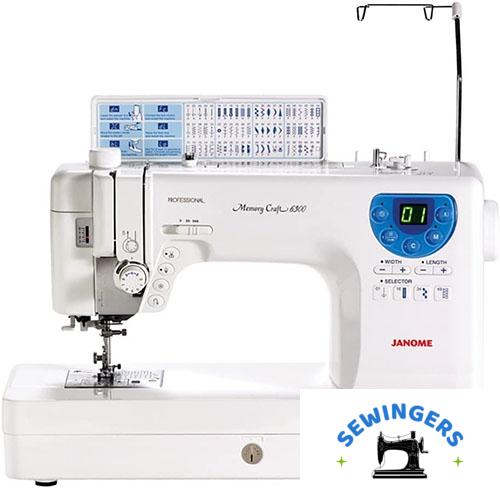
This one’s in a different category from the others on this list — in terms of price, features, and who it’s actually designed for. The Janome Memory Craft 6300P is a computerized, professional-grade machine built for sewists who are past the learning phase and want precision and speed to match their skill level.
The stitch count alone tells you something: 66 built-in stitches and 4 buttonhole styles. At 1,000 stitches per minute, it’s faster than most machines in this roundup, and the 9″ x 5″ throat space genuinely accommodates large quilts without the fabric bunching up or dragging. The included extension table adds even more usable workspace — something quilters especially will appreciate.
The LED display gives you clear information while you’re working, and the bobbin area and twin needle zone both have indicator lights, so you can monitor thread levels even in low-light conditions. Block script monogram stitches are built in for decorative work. The automatic thread cutter trims excess cleanly. A knee lifter raises the presser foot hands-free, which is useful when you’re managing multiple fabric layers and can’t spare a hand.
For appliqué, there are 5 blanket stitch options. The upgraded feed system handles thick fabrics consistently. There’s a hand-look quilt stitch option if you want that handcrafted appearance without doing it entirely manually.
The learning curve here is real — this is not a beginner machine. But for someone who’s been sewing long enough to know exactly what they need, the MC-6300P delivers on most of it.
Pros
- 66 built-in stitches with 4 customizable buttonhole options
- 1,000 stitches per minute with large 9″ x 5″ throat clearance
- Extension table for expanded workspace on large projects
- LED display and indicator lights for bobbin and needle areas
- Automatic thread cutter with memory function
- Knee lifter for hands-free presser foot management
- Drop feed controller for free-motion work
- Multiple blanket stitch options for appliqué
Cons
- One user reported stitch skipping after only three uses — worth monitoring early on
- At least one buyer had a significantly negative experience overall
Final Recommendation
For most people reading this, the Brother ST371HD is the right call — especially if you’re dealing with a wide mix of fabrics or doing a lot of repair and construction work. The balance of durability, stitch options, and usability across skill levels makes it a practical everyday machine that doesn’t ask too much of you.
If you’re at a more advanced stage and specifically focused on quilting or high-volume professional work, the Janome MC-6300P is worth the investment. The 66 stitches, extended throat space, computerized controls, and 1,000 SPM are genuinely useful at that level — not just impressive on paper.
Both machines are genuinely capable. The better question isn’t which one is objectively superior, but which one fits where you actually are in your sewing life right now.