After my last article on sewing machines got more response than I expected, a lot of readers had the same follow-up question: what do you actually put it on?
Fair point. A decent sewing machine on a wobbly kitchen table is a frustrating combination. The right table makes the whole setup feel intentional — and it protects your work, your posture, and your machine. So I went through seven of the most commonly recommended options, looked at what each one actually offers, and put together this breakdown.
No filler. Just what matters.
Contents
- 1 7 Best Sewing Machine Tables
- 1.1 1. South Shore Crea Sewing Craft Table on Wheels
- 1.2 2. South Shore Artwork Craft Table with Storage
- 1.3 3. Sullivans Quilter’s Table
- 1.4 4. Studio Designs Eclipse Sewing and Craft Table, Black/White
- 1.5 5. Sauder Sewing Craft Cart, Cinnamon Cherry Finish
- 1.6 6. Sauder Soft White Sewing and Craft Table
- 1.7 7. Sewing / Craft Center – Folding Table
- 2 What to Look for in a Sewing Machine Table
- 3 Can You Use a Regular Desk as a Sewing Table?
- 4 Final Thoughts
- 5 FAQ
- 5.1 What height should a sewing table be?
- 5.2 Do I need a special table for a heavy sewing machine?
- 5.3 Is a sewing table worth it over a regular desk?
- 5.4 What’s the difference between a sewing table and a sewing cabinet?
- 5.5 Can I put a serger on a sewing table?
- 5.6 How do I keep my sewing table from vibrating?
7 Best Sewing Machine Tables
Here’s the full list we’ll be working through:
- South Shore Crea Sewing Craft Table on Wheels
- South Shore Artwork Craft Table with Storage
- Sullivans Quilter’s Table
- Studio Designs Eclipse Sewing and Craft Table (Black/White)
- Sauder Sewing Craft Cart in Cinnamon Cherry Finish
- Sauder Soft White Sewing and Craft Table
- Sewing / Craft Center Folding Table
Each one hits a different need and price point. I’ve included buying links where available so you can check current pricing without having to hunt around.
1. South Shore Crea Sewing Craft Table on Wheels

The Crea is what I’d call a no-drama table. It does what it says, looks clean, and holds up well to regular use.
The surface is both scratchproof and water-resistant — which matters more than it sounds when you’re working with fabric dye, spray starch, or a coffee cup that shouldn’t be there. It works equally well as a sewing table or a general craft table, so you’re not buying two pieces of furniture for one room.
- Two open storage compartments
- Scratchproof, water-resistant surface
- Rolls easily on lockable casters
- 5-year limited warranty
- Made in Canada
The wheels are genuinely useful — this isn’t a table you have to shove across the floor when you need to rearrange.
2. South Shore Artwork Craft Table with Storage
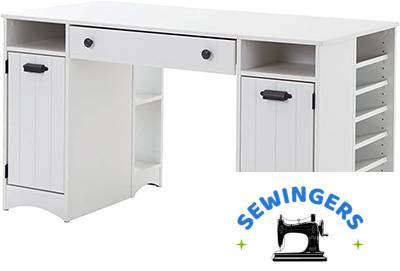
Think of this as the Crea’s bigger sibling. The core design is similar, but South Shore added meaningful storage — three additional spaces with two adjustable shelves — and a noticeably larger work surface.
- 3 extra storage spaces with 2 adjustable shelves
- Larger work surface than the Crea
- Same scratchproof, water-resistant finish
- Made in Canada
If you tend to spread out when you sew — multiple fabric pieces, tools within reach, reference materials nearby — this gives you more room to work without turning your whole space into a craft explosion.
3. Sullivans Quilter’s Table

This one is built specifically for quilters — and it shows. The standout feature is a fold-out melamine surface with a 1-inch gridded top. That grid isn’t decorative; it’s how quilters measure, cut, and square up fabric without pulling out a separate mat every time.
- Fold-out melamine surface with 1″ grid
- High-quality locking casters
- Open dimensions: 47″ L × 35.5″ W × 29.75″ H
- Closed dimensions: 47″ L × 16.5″ W × 29.75″ H
- Roll-out serger storage shelf
When closed, it’s compact enough to tuck against a wall. Opened up, it gives you a real work surface. The serger shelf is a thoughtful touch — most tables ignore the fact that a lot of quilters run a serger alongside their main machine.
4. Studio Designs Eclipse Sewing and Craft Table, Black/White

The Eclipse stands out visually — the black and white finish looks more like furniture than most sewing tables. It’s also built from heavy-gauge steel, which makes it substantially sturdier than wood-composite options at the same price.
- Heavy-gauge steel construction
- Drop-down platform: 22.75″ wide × 10.75″ deep
- Folding side shelf: 9.25″ wide × 23.5″ deep
- Overall dimensions: 44.75″ W × 23.5″ D × 29″ H
- Adjustable platform height
The adjustable platform is worth calling out. Not all machines sit at the same height, and being able to dial that in makes a real difference for long sessions.
5. Sauder Sewing Craft Cart, Cinnamon Cherry Finish
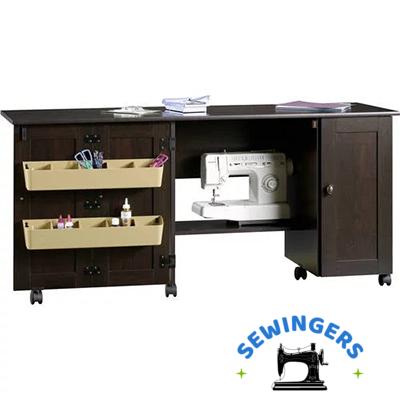
Sauder’s cart option leans more toward traditional furniture styling. The cinnamon cherry finish blends into a home environment better than most sewing-specific pieces, which is useful if your sewing space doubles as a living area.
- Drop-leaf for extended work surface
- Roll-open door with two storage bins
- Adjustable shelving behind the right door
The drop-leaf design means you can expand or contract the work surface depending on the project. Keep it compact for small repairs, open it up for larger cuts.
6. Sauder Soft White Sewing and Craft Table
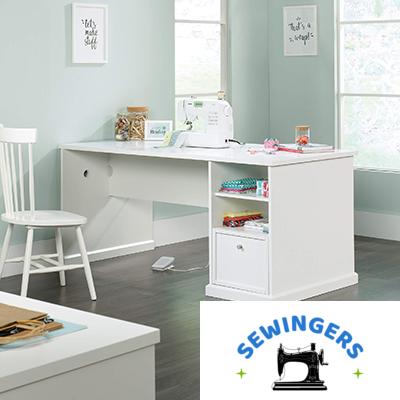
Same core design as the Cinnamon Cherry Sauder, different finish. If your sewing room runs light and airy — white walls, natural light, neutral tones — the soft white finish fits better than the darker wood look.
- 2 storage bins behind the door
- Drop leaf + 2 adjustable shelves
- Dimensions: 40″ W × 19″ D × 28.5″ H
- Soft white finish
Slightly more compact than the cherry version, which can be an advantage if you’re working with a smaller room.
7. Sewing / Craft Center – Folding Table

This is the option for people who don’t have a dedicated sewing room — or who move their setup around regularly. It folds flat for storage and opens into a real working station, not just a card table with ambitions.
- Folding design for compact storage
- Drop leaf for extra surface
- 2 storage bins behind the door
- 2 adjustable shelves
Works for all skill levels. If you sew at a kitchen table now and keep wishing for a dedicated space, this is a reasonable first step that doesn’t require a room renovation.
What to Look for in a Sewing Machine Table
Most people overthink this. There are really only a handful of things that actually matter when you’re choosing a table.
Size relative to your space
Measure first. Not the table listing — your room. The table needs to fit comfortably with space to push your chair back, open fabric, and move around without knocking into walls. A table that looks compact online can feel enormous in a 10×10 room.
Stability
A wobbly table makes precise sewing much harder. The vibration from the machine amplifies any instability, and you end up fighting your setup instead of your project. Steel-frame and solid-wood options tend to hold up better than particle-board-only builds.
Storage that matches how you actually work
Some sewers want everything in one place — threads, scissors, bobbins, presser feet. Others prefer a clear surface and a separate storage system nearby. Be honest about which one you are before you prioritize storage features.
Ergonomics
Standard desk height is around 29–30 inches, which works for most sewers at a standard chair height. If you’re tall, short, or have back issues, look for adjustable-height options. Sitting at the wrong height for two hours will let you know quickly.
Portability — only if you need it
Folding or wheeled tables trade some stability for mobility. If you sew in one spot and never move, don’t pay extra for portability you won’t use. If you share space or teach classes, mobility becomes genuinely valuable.
Your budget, honestly assessed
The cheapest tables work fine for occasional sewers. If you sew several hours a week, it’s worth spending more on something that won’t wobble after six months. Think of it less as a furniture purchase and more as a workspace investment.
Can You Use a Regular Desk as a Sewing Table?
Yes — and a lot of serious sewers do exactly this. A dedicated sewing table is a convenience, not a requirement.
The main things to check: the surface should be large enough for your machine plus some working room on at least one side; the table should be solid enough that the machine’s vibration doesn’t translate into table wobble; and the height should let you sew without hunching.
What a regular desk won’t have is built-in storage or a recessed machine platform. You can work around both — a rolling cart handles storage, and a mat handles surface protection. It’s not a perfect setup, but it absolutely gets the job done while you figure out what you actually want.
Final Thoughts
The right table depends almost entirely on how you sew. A quilter working on large pieces needs something different from someone doing alterations twice a month. Neither of them needs the same thing as someone teaching classes in a small apartment.
Pick the one that fits the space you actually have and the workflow you actually use — not the one with the most features. More storage doesn’t help if you end up ignoring it.
FAQ
What height should a sewing table be?
Most sewing tables sit between 28 and 30 inches tall, which is standard desk height. That works for the majority of sewers using a regular chair. If you’re taller than average or work for long stretches, an adjustable-height option is worth considering.
Do I need a special table for a heavy sewing machine?
Not necessarily special, but definitely solid. Industrial machines and heavier home machines need a table that won’t flex or wobble under load. Look at the weight capacity listed by the manufacturer — most standard tables handle 50–100 lbs without issue, which covers most home machines comfortably.
Is a sewing table worth it over a regular desk?
For occasional sewers, probably not. For anyone sewing regularly, yes — mainly because of the storage and purpose-built surface. The time you save not hunting for scissors or rethreading because a bobbin rolled off the edge adds up.
What’s the difference between a sewing table and a sewing cabinet?
A cabinet typically has a recessed platform that lets your machine sit flush with the work surface — useful for guiding large pieces of fabric. A table has a flat top surface with your machine sitting on top. Cabinets are more expensive and less portable; tables are more versatile.
Can I put a serger on a sewing table?
Yes. Most tables have enough surface for both a sewing machine and a serger, though you’ll want a larger work surface if you’re running both regularly. The Sullivans Quilter’s Table is the only one in this list with a dedicated serger shelf.
How do I keep my sewing table from vibrating?
Anti-vibration pads placed under the machine’s feet help significantly. A heavier, more solidly built table also dampens vibration better than lighter composite options. If your current table shakes noticeably, the pads are a cheap fix worth trying before replacing the table.