I’ll be honest — upholstery sewing sat on my “someday” list for way too long. A torn dining chair cushion, a sofa with a seam splitting on one side, a set of outdoor cushion covers that had seen better days. I kept putting it off because I assumed I’d need some serious industrial setup to handle thick fabric properly. Turns out, you don’t have to go full commercial sewing room to do this well. You just need the right machine.
After a lot of research (and a few frustrating test runs on fabrics that ate through the wrong needle), I’ve pulled together the five best sewing machines for upholstery that actually hold up to the work. Some are industrial-grade, some are more home-friendly — and I’ll tell you honestly which one I think is worth the money.
Contents
- 1 Key Takeaways
- 2 What to Look for in an Upholstery Sewing Machine
- 3 The 5 Best Sewing Machines for Upholstery
- 4 Which Machine Is Right for You?
- 5 Final Thoughts
Key Takeaways
- Upholstery fabrics are thick, layered, and unforgiving — your machine needs a powerful motor and a sturdy metal frame to handle them without skipping stitches or shaking apart.
- A walking foot is one of the most important features for upholstery work because it feeds multiple layers evenly through the machine (without that, you’ll get puckering and uneven seams).
- The Singer 191D-30 is the top pick here — it sews at 4,000 stitches per minute and handles medium to heavy fabrics without hesitation.
- If budget is a concern, the Singer 4411 punches well above its price point for home upholstery repairs.
- Heavy-duty needles and thick thread matter just as much as the machine itself — don’t skip that part.
What to Look for in an Upholstery Sewing Machine
Upholstery isn’t like sewing a cotton blouse. You’re dealing with canvas, vinyl, thick foam-backed fabric, sometimes leather — materials that would snap a lightweight machine needle mid-stitch and leave you with a tangled mess. Before getting into the actual machine reviews, here are the things worth paying attention to.
Machine Build and Frame
This is where a lot of people go wrong. They buy a machine that looks heavy-duty but has a plastic housing, and the moment it hits multiple layers of canvas, it starts vibrating and losing tension. For upholstery, you want metal. Full metal frame, metal interior components, and ideally a machine that feels like it has some real weight to it when you pick it up.
That said, if you’re working on lighter upholstery projects — recovering dining chairs, making throw pillow covers, repairing cushion seams — you don’t necessarily need a full industrial machine. A heavy-duty domestic machine with a metal frame (like the Singer 4411 or the Janome HD3000) will handle that just fine.
Motor Power
The motor is what determines whether your machine glides through thick fabric or strains and stalls. Domestic machines typically run somewhere in the range of 0.5 to 1.0 amps. Industrial machines run much higher — the Singer 191D-30, for example, uses an industrial-grade motor that lets it sew at 4,000 stitches per minute without losing any consistency.
For heavy upholstery (think car seats, thick outdoor furniture cushions, multi-layer canvas projects), you’ll want that kind of power. For standard home repairs, a strong domestic motor gets the job done.
Needle and Thread Compatibility
A delicate needle will snap clean off the moment it hits a thick seam allowance on upholstery fabric. You need heavy-duty needles — typically size 16 to 18 for medium fabrics, size 19 to 21 for leather and very heavy materials. (The Rex 607 specifically recommends a 135 x 17 size 22 needle with nylon #69 bonded thread, and that combo really does make a difference on leather and canvas.)
Thread matters too. Regular all-purpose polyester thread won’t hold up under the tension that upholstery seams experience. Use upholstery thread — it’s thicker, stronger, and made to flex and hold without breaking down over time.
Walking Foot
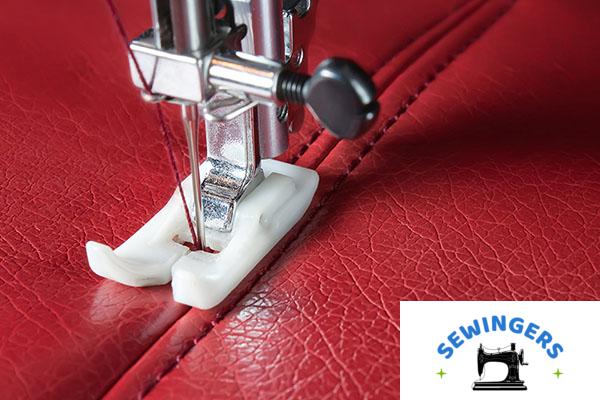
If I had to pick one feature that separates a good upholstery machine from a frustrating one, it’s this. A walking foot (sometimes called an even-feed foot) grips the top layer of fabric and moves it through at the same rate as the feed dogs move the bottom layer. Without it, thick materials slip and shift, and you end up with seams that wander or layers that don’t line up properly.
Some machines come with a built-in walking foot mechanism. Others include one as an accessory. Either way, make sure your machine can work with one before committing.
Extra Features Worth Having
Reverse stitch is non-negotiable for upholstery — you need to lock every seam start and end, otherwise the whole thing unravels under use. A free arm is helpful for getting into tight spots on cushion covers or piped edges. Adjustable presser foot pressure lets you dial in the right amount of grip for different fabric thicknesses. And if you’re doing long projects, a large bobbin capacity means fewer stops to rewind (which is honestly one of the most annoying interruptions mid-project).
The 5 Best Sewing Machines for Upholstery
1. Singer 4411 Heavy Duty Sewing Machine
The Singer 4411 is one of those machines that surprises you. It looks like a standard home sewing machine, and then you start running it through denim and canvas and realize it genuinely doesn’t care. The metal interior frame gives it real stability, and the motor pushes out 1,100 stitches per minute — which is fast for a domestic machine and more than enough for most home upholstery repairs.
It comes with 11 built-in stitches, including 6 basic stitches, 4 decorative options, and a 4-step buttonhole. Honestly, for upholstery you’re mostly just using straight stitch anyway, so the stitch variety is a nice bonus but not the reason to buy this one. The reason to buy it is the combination of the metal frame, the adjustable stitch length, and the price point.
The top drop-in bobbin has a clear cover so you can see at a glance how much thread is left (I always seem to run out right in the middle of a long seam — this at least lets you catch it before it happens). The adjustable presser foot pressure means you can actually move between lightweight fabric and heavier materials without fighting the machine.
One honest note: there’s no automatic needle threader, which is a minor annoyance. And a few users have mentioned that keeping the needle in the exact center position for perfectly straight stitching is trickier than it should be. Not a dealbreaker, but worth knowing.
For recovering dining chairs, repairing sofa cushions, making pillow covers, or general home upholstery repairs — this machine is genuinely great and one of the most wallet-friendly ways to get there.
Pros
- Metal interior frame for real stability on thick fabrics
- 1,100 stitches per minute — fast for a domestic machine
- Adjustable stitch length and width for customizing each project
- Adjustable needle position with 3 settings for cording and topstitching
- Top drop-in bobbin with transparent cover
- Built-in reverse stitch to lock seams
- Free arm included for sewing around curved shapes
- On-board accessory storage
- Works on everything from lightweight sheers to heavyweight denim and canvas
Cons
- No automatic needle threader
- Centering the needle for perfectly straight stitching takes some trial and error
2. Rex 607 Portable Walking Foot Sewing Machine
Rex isn’t a name that shows up in the mainstream sewing conversation very often, but people who sew leather and canvas regularly tend to know it. The 607 is a full cast iron machine built to industrial standards — it’s heavy, it’s solid, and it does not shake when you push it through tough materials. That alone sets it apart from a lot of “heavy duty” machines that vibrate the moment you hit a thick seam.
The built-in walking foot is the real selling point here. It handles leather, denim, thick canvas, and upholstery fabric with a consistency that’s hard to replicate with a domestic machine and an accessory walking foot. The feed is even, the stitch quality holds up, and it can run for long sessions without losing its composure.
It’s worth being honest about what this machine is and isn’t. It sews straight stitch only. No decorative options, no zigzag, no buttonhole — just a single clean straight stitch, done reliably for as long as you need it to. For upholstery and leather work, that’s often exactly what you want. But if you’re looking for a versatile all-rounder that also handles garment sewing or quilting, this isn’t it.
Rex recommends nylon #69 bonded thread with a 135 x 17 size 22 needle, and the machines actually ship with a pre-sewn leather sample so you can see how it performs right out of the box. A few users have noted it feels a little tight initially, and one mentioned the oiling holes were tricky to locate (which matters for long-term maintenance). Those are real limitations worth knowing.
Pros
- Full cast iron metal body — genuinely industrial construction
- Built-in walking foot handles leather, denim, canvas, and upholstery without slipping
- No vibration even on thick multi-layer materials
- Every machine is pre-tested to industrial standards before shipping
- Portable enough to move around your workspace
- Ships with a pre-sewn leather patch as a sample
- Excellent stitch consistency over long sessions
Cons
- Straight stitch only — no versatility for other sewing projects
- Can feel stiff initially before it’s broken in
- Oiling access points are not the most intuitive to find
- One user reported some shakiness (though most reviews don’t mention this)
3. Singer 191D-30 Industrial Sewing Machine
This is the one. If you’re serious about upholstery — bulk projects, regular use, medium to heavy fabric — the Singer 191D-30 is the machine that handles all of it without breaking a sweat. It sews at 4,000 stitches per minute, which is roughly six times faster than a standard domestic machine. That speed isn’t just about getting things done quickly — it means the motor has real power reserves, so it doesn’t strain or lose tension when it hits a tough seam.
The industrial-grade motor sits in an oil reservoir (the self-lubrication system keeps everything running smoothly without you having to stop and manually oil it). The H-leg stand keeps the machine completely stable at high speeds — there’s no vibration, no drift, no feeling like the whole setup is going to walk across your table. It arrives fully assembled, which honestly saves more time than you’d think.
The knee lifter is a feature I didn’t know I wanted until I tried it. It lets you raise and lower the presser foot hands-free, which makes repositioning thick fabric between seams so much easier — especially when you’re working with something bulky like a sofa cushion that’s hard to maneuver with both hands already managing the fabric.
The sewing table is 50 inches long, which gives you real room to spread out large projects. The reverse lever reinforces every seam. The tabletop bobbin winder lets you wind new bobbins without stopping your sewing. Stitch length goes up to 5mm, which is great for heavier upholstery thread.
The honest caveat: this machine is pricey, and at least one user recommends avoiding leather on it specifically (it’s not designed as a leather machine — the Rex 607 is the better call for heavy leather work). For everything else — canvas, thick upholstery fabric, vinyl, heavy home dec fabric — the 191D-30 is genuinely hard to beat.
Pros
- 4,000 stitches per minute with industrial-grade motor
- Self-lubrication system — no manual oiling required
- Knee lifter for hands-free presser foot control
- 50-inch table top for large, spread-out projects
- H-leg stand keeps everything completely stable at high speeds
- Arrives fully assembled — no setup headache
- Stitch length adjustable up to 5mm
- Tabletop bobbin winder so you can rewind without stopping
- Reverse lever to reinforce every seam
- Includes needles, screwdrivers, oil container, bobbins, and straight stitch foot
- Handles medium to heavyweight fabric with no strain
Cons
- Higher price point (though reviews consistently say it’s worth it)
- Not ideal for leather specifically — stick to upholstery and canvas fabrics
4. Consew 206RB-5 Industrial Sewing Machine
The Consew 206RB-5 sits in similar territory to the Singer 191D-30 — it’s a serious industrial machine, built for real upholstery work, with features that make long sessions manageable rather than exhausting. What sets it apart is the extra-long stitch length, which gives you more flexibility for heavy thread and thick seam allowances, and the centralized arm lubrication system that keeps things running smoothly without constant maintenance stops.
The compound walking foot and needle feed mechanism work together to keep fabric moving evenly through the machine — even on multiple thick layers. For auto upholstery, outdoor furniture, or anything where you’re stacking several layers of heavy material, that even feed matters a lot. Uneven feeding is what causes seams to pucker and wander, and the 206RB-5 handles it well.
The presser foot lifts up to 9/16 inches, which is higher than most domestic machines (helpful for getting bulky projects seated properly under the foot). There’s also a thread release finger for thick and heavy thread, a locking stitch regulator that prevents your stitch length from shifting due to vibration, and a safety clutch with push-button re-engagement if the mechanism jams.
The large bobbin can be swapped out while the fabric is still in place, which is genuinely useful on long continuous projects. The flexible reverse stitching secures seams cleanly at both ends.
A few real-world notes from users: threading the needle takes some learning, the machine is louder than domestic options (industrial machines generally are), and the thread path isn’t totally intuitive at first. None of these are unusual for this class of machine, but they’re worth knowing if you’re coming from a home sewing background.
Pros
- Compound walking foot and needle feed for even fabric movement on multiple layers
- Extra-long stitch length for more flexibility with heavy thread
- Centralized arm lubrication with micrometric oil control
- Presser foot lifts up to 9/16 inches to accommodate bulk
- Locking stitch regulator — stitch length won’t shift from vibration
- Large bobbin swappable mid-project
- Safety clutch with push-button re-engagement
- Handles leather, upholstery fabric, canvas, and heavy materials
Cons
- Threading the needle takes practice to figure out
- Noticeably loud — typical for industrial machines, but worth knowing
- Thread path options can be confusing at first
5. Janome HD3000 BE Sewing Machine
The Janome HD3000 BE is the most well-rounded machine on this list. It’s not industrial — it won’t run at 4,000 stitches per minute or handle commercial upholstery volume — but for home sewers who want a reliable heavy-duty machine that handles upholstery repairs and a dozen other projects, it covers a lot of ground in one package.
The black edition comes with an exclusive bonus bundle that includes a quarter-inch seam foot, a cloth guide, a five-piece quilting kit, a darning foot, a craft foot, a quilt guide, an even-feed foot, and a five-year extended warranty. That’s a genuinely useful accessory set, not just packaging filler. (The even-feed foot in particular is what you’ll reach for on upholstery work — it functions like a walking foot and makes a real difference on layered projects.)
It runs at 860 stitches per minute, which is steady and consistent for a domestic machine. The metal frame keeps it stable on thick fabrics. It has 18 built-in stitches with a one-step buttonhole, adjustable stitch length (up to 4mm) and width (up to 6.5mm), a convertible free arm, five-piece feed dogs, and a hinged faceplate. The automatic needle threader is a nice touch — it’s one of the features people mention most in reviews because threading by hand on a heavy-duty needle gets old fast.
The drop-in bobbin has a transparent window (so you can see the thread level without stopping and lifting anything), and the machine doesn’t jump or vibrate on heavier projects. It’s also described as relatively quiet compared to other heavy-duty machines, which matters if you’re sewing during nap time or in a shared space.
Honest caveats: one user said the LED light is dim. Another reported receiving a unit with threading issues right out of the box (though this seems like a manufacturing outlier, not a common complaint). And there’s some debate about leather — one reviewer said it can’t handle leather, others say they’ve sewn leather on it without problems. My read is that it handles light to medium leather fine, but I wouldn’t push it through thick upholstery leather.
Pros
- 18 built-in stitches with one-step buttonhole
- Comes with an extensive bonus accessory bundle including even-feed foot
- Automatic needle threader
- Five-piece feed dogs keep heavy projects tracking straight
- Metal frame — stable and durable
- Relatively quiet for a heavy-duty machine
- Drop-in bobbin with transparent window
- Convertible free arm for round shapes and tight spots
- Five-year extended warranty included
- 860 stitches per minute — steady and consistent
Cons
- LED light is on the dim side
- Occasional reports of threading issues on arrival (rare, but worth inspecting out of the box)
- Not the best choice for thick leather upholstery
Which Machine Is Right for You?
It depends a lot on what you’re actually sewing. Here’s a quick way to think through it:
If you’re doing mostly home repairs — recovering dining chairs, patching sofa seams, making new cushion covers — the Singer 4411 or the Janome HD3000 BE will handle that easily, and you don’t need to spend industrial money to get there.
If leather is your main focus, the Rex 607 is the one. It’s built specifically for that kind of work, and the consistent feed quality shows.
If you’re doing larger-scale upholstery — reupholstering full pieces of furniture, working with thick multi-layer materials, or taking on volume — the Singer 191D-30 is worth every penny. The speed, the stability, the self-lubrication, the large work surface — it’s genuinely set up for serious work.
The Consew 206RB-5 is worth considering if you specifically need the extra-long stitch length and compound feed for very heavy auto upholstery or outdoor furniture fabric. It’s a more specialized tool, but a great one for that application.
Final Thoughts
Upholstery sewing used to feel like this intimidating specialty — like you needed a whole separate studio setup to attempt it. Honestly, it’s more approachable than it looks once you have the right machine under your project. The main things that matter are motor strength, frame stability, and the ability to feed thick layers evenly without the whole thing turning into a stitching disaster.
My top pick is the Singer 191D-30, and I’d feel good recommending it to anyone doing real upholstery work on a regular basis. For home repairs and lighter projects, start with the Singer 4411 — it’s a workhorse that won’t break your budget and genuinely holds up.
I hope this helps you find the right machine for whatever project has been sitting on your someday list. Let me know if you have questions in the comments!