There’s something about denim that just sticks with you. It doesn’t go out of style, it doesn’t give up easily, and honestly — neither do the people who sew it. If you’ve ever wrestled with a thick pair of jeans at the seams, you already know what this is about. Getting those stitches right isn’t just satisfying; it’s the whole point. And finding a machine that can actually handle it? That’s where things get interesting.
The JUKI MO644D Serger sits at the center of that conversation. It’s not a flashy machine — compact, lighter than you’d expect — but it moves through denim at 1,500 stitches per minute without flinching. That kind of output changes how you approach projects. Suddenly, the fabric stops being the hard part.
But before landing on any single machine, it helps to understand what actually matters when you’re sewing denim. Not the specs that look good on paper — the stuff that shows up when you’re halfway through a project and your seams start pulling.
Contents
- 1 Factors to Consider While Choosing A Sewing Machine For Denim And Jeans
- 2 5 Top-Rated Sewing Machine For Denim And Jeans With Reviews
- 3 Key Takeaways
- 4 Practical Tips for Sewing Denim and Jeans
- 5 Conclusion
Factors to Consider While Choosing A Sewing Machine For Denim And Jeans
Picking the right machine for denim isn’t about finding the one with the most features. It’s about knowing which features you’ll actually use — and which ones will quietly collect dust. The more clearly you understand your own projects, the easier this decision becomes.
Here’s what tends to matter most in practice.
The Motor: Where It All Starts
You can have a machine loaded with every stitch imaginable, but if the motor struggles through thick fabric, none of it matters much. The motor is what keeps everything moving — consistently, without bogging down — and that consistency shows in your finished seams.
For heavy-duty work like denim, a stronger motor isn’t a luxury. It’s what separates a machine that handles your project from one that merely survives it. When you’re layering four or five pieces of denim, you want a motor that doesn’t slow mid-seam. That hesitation is usually where things go wrong.
The Machine Body: More Than Just Weight
Here’s something that doesn’t always get enough attention — a machine with a flimsy frame will vibrate. And vibration, when you’re sewing something as dense as denim or canvas, throws off your stitch line in ways that are hard to fix after the fact.
A heavier, metal-framed body keeps the machine planted. It’s not glamorous. But when you’re feeding a stiff piece of double-layered denim through at speed, stable beats lightweight every time. That said, if you’re regularly moving your machine between spaces, there’s a balance to find.
Features Worth Actually Looking For
An automatic needle threader sounds like a small thing — until you’ve spent ten minutes squinting at a size 100 needle under bad lighting. Features like that add up. Adjustable stitch length, a tension dial, reverse stitch — these aren’t extras, they’re the core of what makes a machine genuinely useful rather than just technically capable.
Bonus features worth noting if they’re there: a jam-resistant drop-in bobbin, built-in LED lighting, speed control, and an extension table. None of these are dealbreakers on their own. But a machine that bundles several of them together tends to get out of your way when you’re in the middle of a project.
Stitches: Enough Is Enough
More stitches sounds better. In practice, it’s not always. For denim work, you’re most likely reaching for straight stitches, reinforced zigzag, and maybe a topstitch option. A machine with 34 built-in stitches sounds impressive — and it can be — but if your projects are focused, a machine with fewer, well-executed stitches will serve you just as well.
That said, if you sew across a wide range of projects and fabrics, having more stitch variety does open things up. It really depends on how you work.
Speed Control: Not About Going Fast
Variable speed control isn’t for people who want to sew faster. It’s for people who want to sew accurately. When you’re easing around a curve, or starting a seam on a thick denim edge, slowing down precisely is what keeps things clean.
On thicker fabric, lower speed also tends to give you stronger seam penetration — the needle drives through more deliberately rather than skating over the surface. It’s one of those things that’s hard to explain until you’ve sewn both ways and compared the results.
5 Top-Rated Sewing Machine For Denim And Jeans With Reviews
1. JUKI MO644D Serger Sewing Machine
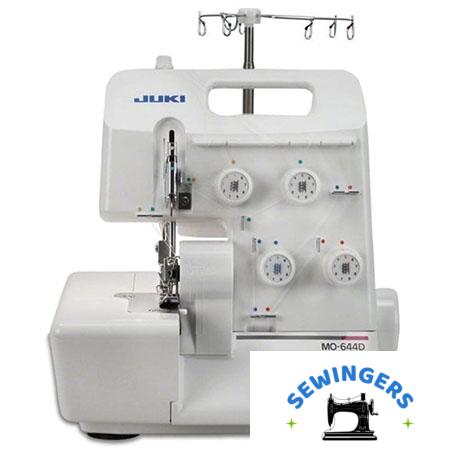
JUKI has been doing this long enough to know what actually works in the field — not just what looks good in a catalog. Their machines tend to lean on industrial principles even in the consumer range, and the MO644D is a solid example of that approach.
It’s compact. Dimensions land at 10.6″ x 13.4″ x 11.6″ — light enough to pack up and take to a class, small enough to fit in a corner. Don’t let that fool you, though. This machine runs at 1,500 stitches per minute and works through denim and stacked heavy fabrics without the hesitation you might expect from something this portable.
The thread setup is convertible — 2/3/4 thread serger — with an automated rolled hem function. Stitch options cover 4-thread overlock, 3-thread flatlock, 3-thread overlock, 3-thread rolled hem, 3-thread narrow overlock, and 2-thread rolled hem. Color-coded threading and a breakaway looper make setup more manageable, and the upper knife design keeps the threading access clear. Differential feed, flexible stitch length, and a multi-purpose foot round things out.
What you’ll notice pretty quickly: this machine doesn’t require a heavy investment in skill to get started. Experienced sewists will appreciate the speed and precision. Newer users can grow into it.
Pros
- Lightweight, portable, and genuinely fast at 1,500 stitches per minute
- Works through denim and multiple stacked heavy fabric layers
- Multi-purpose foot handles a wide range of fabric types and finishes
- 2/3/4 thread convertible serger with automatic rolled hem
- Single and double needle options open up more design possibilities
- Adjustable presser foot knob for varied fabric thickness
- Sturdy enough to travel with — to classes or on the go
Cons
- Threading involves quite a few steps — buyers have mentioned this takes some getting used to
- No ON/OFF switch for the cutting knife, which some users found limiting
- At least one buyer reported receiving the machine without a manual or tools — worth checking the package on arrival
2. TOYOTA Super Jeans J34 Sewing Machine
Toyota’s name carries a reputation built in the automotive world, and they’ve carried similar quality standards into their sewing machines — though that’s still a claim worth testing against real use.
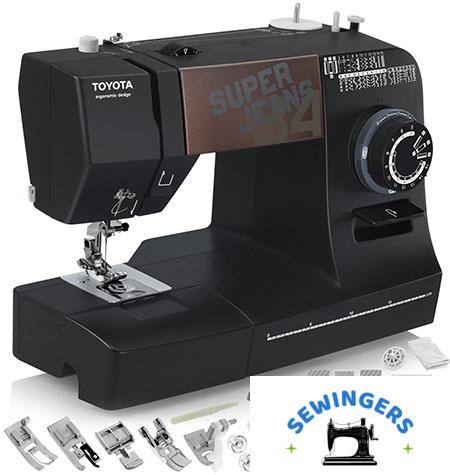
The J34 comes in a sleek black/brown finish with an attached extension table measuring 11.8″ x 16.5″. That’s a meaningful amount of workspace when you’re managing a heavy, flowing piece of denim. The built-in measuring ruler is a small touch that actually speeds things up more than you’d expect.
Stitch capacity sits at 34 built-in options, displayed on a convenient panel that includes stretch stitches, blind hem, utility stitches, decorative options, overlock, 4-way smocking, triple reinforced zigzag and straight stitches, applique, and a 4-step buttonhole. Drop feed function handles buttons, darning, and free motion work. On paper — and mostly in practice — it’s well-equipped.
The machine handles soft denim stacked 9–12 layers deep, and hard denim up to 9 layers. Features like the automatic needle threader, dial-controlled presser foot pressure, and free arm mechanism make it comfortable for regular use. Remove the table, and you get free arm access for sleeves, cuffs, and smaller circular openings.
Accessories included: zigzag foot, gliding foot, overcasting foot, zipper foot, buttonhole foot, blind hem foot, wide extension table, 3 needle packs, spool cap, spool pin, advisor guide, bobbins, screwdriver, felt, soft cover, foot control, seam ripper, instruction book, and warranty card.
Pros
- 34 built-in stitches covering practically the full spectrum of sewing needs
- Stitch panel makes selecting stitches, letters, or numbers quick and visual
- Extension table gives real working room for large, heavy fabrics
- Handles everything from delicate silk and nylon to thick denim and canvas
- Soft dust cover included to keep the machine protected between uses
- Free arm operation accessible by removing the extension table
- Comes with a thorough accessories bundle — not much to buy separately
Cons
- One buyer found the machine unstable during sewing — vibration was a concern for them
- Another user reported difficulty managing more than 3–4 layers of even light fabric, which raises questions about its real-world heavy-duty limits
3. SINGER Simple 3223G Sewing Machine

Singer has been around long enough that most people have an opinion about the brand before they even look at the specs. That reputation — reliable, accessible, feature-packed — holds up reasonably well with the Simple 3223G.
What makes this one interesting is the internal metal frame. It’s built to hold its alignment over time, which is exactly what you want when skip-free, consistent stitching matters. That kind of structural backbone tends to outlast machines that look similar on the outside but flex under pressure.
23 built-in stitches come standard, paired with an automatic 4-step buttonhole. Stitch length and zigzag width are both adjustable. Four needle positions. A 4-segment feed dog. Snap-on presser feet (four of them) cover regular sewing, buttonholes, zippers, and button sewing — and swapping them out doesn’t require a screwdriver, which is genuinely useful mid-project.
The free arm makes sleeves and cuffs accessible. On-board storage keeps your tools within reach. Automatic bobbin winding means you’re not manually stopping to refill constantly.
The box includes: four snap-on feet, darning plate, 2 spool caps, edge/quilting guide, screwdriver, Class 15 bobbins, seam ripper/lint brush, needle pack, soft-sided dust cover, auxiliary spool pin, power cord, instruction manual, foot pedal, and an intro DVD. 25-year limited warranty.
Pros
- Heavy-duty metal internal frame keeps alignment consistent over time
- 23 built-in stitches with an automatic 4-step buttonhole
- Automatic bobbin winding — one less thing to stop for
- Raised presser foot lifter for sewing multiple fabric layers together
- Free arm access for circular hems and tight spaces
- 4 snap-on presser feet, no screwdriver needed to swap
- Adjustable stitch length and zigzag width
- 25-year limited warranty — that’s reassuring
Cons
- One user reported tension adjustment inconsistencies — stitch length apparently shifting with speed changes
- Bobbin winding gave at least one buyer trouble
- Described by some as functional but not exceptional — fair assessment for the price range
4. Brother ST531HD Sewing Machine

Brother has a way of making machines that don’t feel like a compromise — compact and portable, but still built with the kind of metal internal frame that stays stable after hours of continuous use. The ST531HD falls squarely in that category.
It handles everyday alterations just as comfortably as heavier projects — denim, leather, up to 6 layers of stacked fabric. But here’s something worth understanding: which needle you’re using matters as much as the machine itself. Heavy-duty needles for thick denim, appropriate speed for the thickness — that coordination is what actually produces clean results. The machine can do its part; the setup is yours.
For jeans specifically, the spring action zigzag foot handles hems well. A non-stick foot keeps things moving on materials that tend to drag. The metal needle plate speeds up fabric feeding, and a metal finger guard offers some protection during intensive sessions — small detail, but a useful one.
Automatic needle threader handles the part most people find tedious. Anyone from a beginner to an experienced sewist should be able to get comfortable with this machine fairly quickly, though newer users doing complex projects might want to practice on scrap fabric first.
Pros
- Compact and portable with a stable metal internal frame
- Handles up to 6 layers of denim without difficulty
- Spring action zigzag foot designed specifically for jeans hems
- Non-stick foot for fabrics that tend to catch or drag
- Metal finger guard for safer use during intensive work
- Automatic needle threader speeds up setup
- Heavy-duty needles included — built for the type of work this machine does
- Accessible for all skill levels
Cons
- The user manual could be more detailed — a few buyers mentioned this
- One user struggled sewing even 3 layers of a fuzzy fabric — may depend on material type and needle selection
5. Janome MOD-8933 Serger Machine
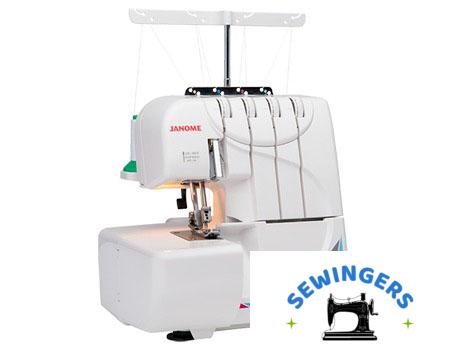
Janome’s MOD-8933 is the kind of serger that earns its place gradually — you might not immediately appreciate everything it does, but after a few projects you start to notice how much it’s handling quietly in the background.
The 3 and 4 thread stitching options give you flexibility across fabric types. A retractable upper knife handles thread trimming without damaging the fabric underneath — simpler and safer than it sounds. Differential feed takes care of puckering and stretching, which is genuinely useful across a wide range of materials. Turn the dial one way for fabrics that pull; the other for heavier stuff. It’s not complicated once you’ve used it a few times.
Threading gets help from a wide-open left side with a visible setup view, lower looper pretension, and a built-in threading chart. Rolled hem width and length are both adjustable, giving you a decent range of finished looks. Automatic needle threader keeps eye strain manageable during long sessions.
It’s worth being clear about what this machine is: a serger, not a sewing machine. It won’t replace a standard machine. But as a dedicated finishing and edge tool for denim and knit projects, it punches well above what the price suggests.
Package includes: tweezers, serger needle set, 4 thread spools, foot controller, general purpose presser foot, power cord, and an instruction manual. Five-year limited warranty included.
Pros
- Lightweight and good value for what it delivers
- Heavy-duty build keeps it stable under sustained use
- 3 and 4 thread capability for different stitch types
- Differential feed prevents puckering and stretching across fabric types
- Lower looper accessed via pretension slider — no awkward maneuvering
- Rolled hem options are quick to switch between
- Lay-in threading system with color-coded instructions
- Solid accessory bundle and strong performance for the price
Cons
- Cannot function as a standard sewing machine — dedicated serger only
- Moving parts aren’t covered, which one buyer flagged as a potential safety concern
- No free arm, and internal storage space is absent
- Worth inspecting the machine as soon as it arrives
Key Takeaways
Out of the five machines reviewed here, the JUKI MO644D Serger stands apart — not because it’s perfect, but because of how consistently it handles what denim sewing actually demands. Speed, stitch variety, thread flexibility, and a frame that doesn’t complain under pressure. If your work centers on denim and jeans construction, it’s the one that keeps showing up as the right answer.
That said — your priorities matter. If you need a full sewing machine rather than a serger, the Brother ST531HD or the Toyota J34 give you more versatility. Singer’s 3223G is worth considering if durability over time is the priority and budget is a factor.
Read through the reviews carefully before deciding. Pay attention to what buyers mention about long-term use, not just initial impressions. The right machine is the one that fits how you actually work — not just the one with the best spec sheet.
Style, after all, isn’t something you buy off a shelf. It’s what happens when you have the right tools and know how to use them.
Practical Tips for Sewing Denim and Jeans
Working with denim consistently teaches you things no guide fully prepares you for. Here are the ones that tend to matter most:
- Needle selection: A heavy-duty or denim-specific needle — size 90/14 or 100/16 — makes a real difference when pushing through thick layers. Using the wrong needle is often where problems start, not the machine itself.
- Thread quality: Polyester or dedicated topstitching thread holds up better under the stress of multi-layer denim sewing. The thread finish also affects how the seam looks from the outside, which matters if you care about the result.
- Machine settings: Longer stitch length reduces puckering and reinforces seam strength on denim. Test your tension settings on a fabric scrap first — it’s faster than fixing a seam that’s already in the wrong place.
- Preshrink your fabric: Before any cutting begins, wash and dry your denim. Shrinkage after construction is a fixable problem, but it’s easier to avoid entirely.
- Cutting tools: Sharp scissors or a rotary cutter give you cleaner edges on dense fabric. For marking, tailor’s chalk or clips work better than standard pens — the marks stay removable.
- Seam finishing: Serging, zigzag stitching, or pinking shears all prevent fraying. French seams work well if you want a cleaner finish on the inside.
- Topstitching: Longer stitch length plus a contrasting thread color gives topstitching its structure and visual weight. Press seams open first — it shows in the finished result.
- Pressing: A hot iron with steam does more for denim seams than most people expect. A tailor’s ham or sleeve board is useful for curved sections that won’t lie flat otherwise.
- Reducing bulk: On pockets or anywhere layers stack up, trimming and grading seam allowances reduces thickness and makes the garment more comfortable to wear.
- Clips over pins: Pins can distort denim as you feed it through the machine. Binding clips hold pieces more securely without pulling the fabric off grain.
- Belt loops: These take a lot of strain over time. Heavy-duty thread and reinforced stitches at attachment points help them last.
- Hemming: Denim thickness makes hemming trickier than most fabrics. A specialized jeans hemming foot keeps the line consistent. Try the jeans on with the shoes you’ll wear before you finalize hem length.
- Practice first: Spend time on scrap denim before committing to a full project. Getting familiar with how your specific machine handles the fabric saves you from unpicking later.
- Patience with the process: Denim sewing rewards attention to detail more than speed. If a seam isn’t right, it’s worth unpicking and redoing — the difference in the finished garment is usually obvious.
Conclusion
Denim sewing is a craft that respects preparation and punishes shortcuts. The right machine doesn’t make the work easy — it removes the obstacles that don’t need to be there. Once you’ve found a machine that matches how you work, and built up a sense of how denim behaves under different settings, the projects start to take on a quality that feels earned.
That’s the part no machine delivers on its own.