

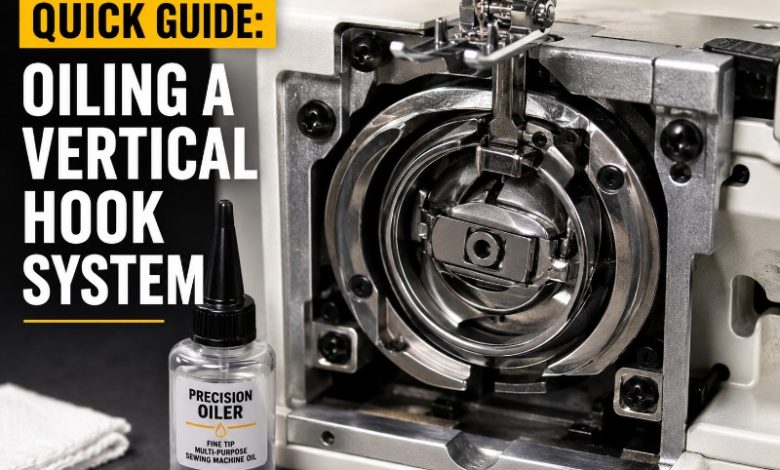
A front-loading vertical hook system runs fast, tight, and unforgiving. Tiny lubrication mistakes turn into expensive repair tickets surprisingly quickly.
That’s the reality inside many U.S. sewing rooms. Upholstery shops in Texas. Quilting studios in Oregon. Small garment operations in New York running machines 8 hours straight during holiday production surges. In those environments, the hook assembly quietly absorbs constant friction at high RPMs while handling delicate thread loop formation with microscopic precision tolerances.
And honestly, the hook system rarely gets attention until something starts sounding wrong.
The interesting part is that vertical rotary hooks don’t actually need much oil. They need correct oil placement. Excess lubrication often creates almost as many problems as neglect. Oil migration, lint sludge, tension inconsistency—it all starts stacking up.
A properly maintained hook race stays cool, rotates smoothly, and produces stable stitch formation under load. A neglected one develops heat, resistance torque, scoring, and eventually mechanical drag that shows up in your stitches before it shows up in catastrophic failure.
For most U.S. users, preventive oiling costs less than a dollar per month. Replacing a damaged rotary hook assembly can run anywhere from $75 to $250 USD before labor even enters the conversation.
That imbalance matters.
Contents
- 1 Understanding the Front-Loading Vertical Hook System
- 2 Identifying When Oiling Is Required
- 3 Tools and Materials Required
- 4 Safety and Machine Preparation
- 5 Step-by-Step: How to Oil a Front-Loading Vertical Hook System
- 6 Advanced Lubrication Strategy for High-Volume U.S. Workloads
- 7 Common Oiling Mistakes (And Their Consequences)
- 8 Integrating Hook Oiling Into a Full Maintenance System
- 9 Expert Tips for Precision and Longevity
- 10 Final Notes for U.S. Users
Understanding the Front-Loading Vertical Hook System
Front-loading vertical hook systems use a vertically mounted rotary hook mechanism positioned behind a removable bobbin case. Industrial straight-stitch machines commonly use this architecture because it handles high-speed operation with excellent stitch consistency.
Horizontal drop-in systems, common in many domestic machines, operate differently. They prioritize convenience and visibility. Vertical hooks prioritize durability, precision, and high-RPM stability.
Here’s the basic structure:
Key Components
Hook Basket
The hook basket supports the bobbin case and maintains rotational alignment during sewing.
Rotary Hook Race
The hook race assembly forms the circular metal channel where lubrication matters most. This area experiences constant metal-on-metal friction during operation.
Bobbin Case
The bobbin case controls lower thread tension through a calibrated tension spring.
Needle Bar
The needle bar synchronizes vertical needle movement with hook timing.
Feed Dogs
Feed dogs move fabric consistently beneath the presser foot during stitch formation.
Now, here’s what experienced technicians notice immediately: vertical hooks tolerate speed better than neglect.
That sounds dramatic, but it’s true. A properly oiled rotary hook running 4,500 stitches per minute can stay stable for years. A dry hook race running half that speed starts developing surface scoring and friction discoloration surprisingly fast.
Identifying When Oiling Is Required
Most advanced users stop relying on calendar reminders after a while. Machines communicate lubrication needs pretty clearly once you know what to listen for.
Signs of Insufficient Lubrication
Metallic Clicking Sounds
Dry hook races produce a sharper mechanical sound during rotation. It’s subtle at first. Then suddenly it isn’t.
Inconsistent Stitch Tension
Oil film breakdown increases friction resistance inside the rotary path, affecting thread loop formation.
Thread Shredding
Increased drag and heat buildup create rough surfaces that gradually damage thread fibers.
Heat Near the Hook Assembly
A warm hook area after light sewing usually indicates lubrication loss or particulate contamination.
Hook Race Discoloration
Bluish or darkened metal surfaces often point toward thermal expansion stress and insufficient lubrication.
In American small-business sewing environments, recommended duty cycles regularly get ignored—not intentionally, just realistically. Machines in tailoring shops or upholstery businesses often sew continuously for 6 to 10 hours daily.
That changes maintenance math completely.
A hobbyist quilting machine used twice weekly experiences a completely different wear cycle than an industrial Juki running denim hems all afternoon. What tends to happen is that users underestimate cumulative friction because the machine still technically “works.”
Until one day the stitches suddenly don’t look right anymore.
Tools and Materials Required
Using the correct lubricant matters more than many people expect.
Automotive oils, household lubricants, and multi-purpose sprays create residue buildup that eventually attracts lint and forms abrasive sludge. And yes, WD-40 continues showing up in sewing rooms across the country despite being a water-displacement product rather than a true long-term lubricant.
Recommended Materials
| Tool or Material | Purpose | U.S. Brand Examples | Notes |
|---|---|---|---|
| ISO 10 clear sewing machine oil | Lubricates hook race | Singer, Dritz | Low-viscosity mineral oil |
| Precision oiler bottle | Controlled application | Zoom-Spout | Prevents over-oiling |
| Lint-free cloth | Removes residue | Microfiber cloths | Avoid paper towel fibers |
| Cleaning brush | Clears lint accumulation | Sewing machine cleaning kits | Soft bristles work best |
| Small screwdriver | Removes components | Generic precision sets | Useful for bobbin area access |
A few practical differences become obvious after long-term use.
| Oil Type | Performance in Vertical Hooks | Long-Term Effect |
|---|---|---|
| Clear ISO 10 mineral oil | Excellent capillary action and clean dispersion | Minimal residue buildup |
| Synthetic sewing oil | Stable under heat and high RPMs | Higher cost but excellent thermal resistance |
| WD-40 | Temporary slickness only | Residual contamination and sludge |
| Cooking oils | Polymerizes under heat | Severe mechanical drag over time |
The difference between mineral sewing oil and household substitutes becomes obvious after several months. Proper sewing oil evaporates cleanly and maintains lubricity under sustained motion. Improvised lubricants break down unpredictably.
And honestly, repairing varnished hook assemblies caused by cooking oil contamination is miserable work.
Safety and Machine Preparation
Preparation determines whether lubrication helps or hurts.
Skipping cleaning before oiling usually turns lint into abrasive paste. That paste circulates directly through precision tolerances inside the hook race assembly.
Proper Preparation Steps
- Power off the machine completely.
- Unplug the machine from the wall outlet.
- Remove the needle and presser foot.
- Remove the bobbin case carefully.
- Clean lint and thread debris thoroughly before applying oil.
Static debris and particulate contamination collect aggressively around high-friction areas. Feed dog cavities and bobbin compartments trap compressed lint surprisingly fast, especially when sewing cotton or fleece fabrics.
One overlooked detail matters here: clean first, oil second.
A lot of users reverse that order accidentally. Then the fresh oil immediately captures hidden lint particles inside the hook race channel. Mechanical clearance starts tightening little by little after that.
Step-by-Step: How to Oil a Front-Loading Vertical Hook System
Precise oil placement matters far more than oil quantity.
Step 1: Clean the Hook Race
Use a soft cleaning brush and lint-free cloth to remove debris from the hook race channel.
Pay attention to corners near the rotary path. Compact lint often hides there. Some technicians use compressed air, although in practice that occasionally pushes debris deeper into the mechanism.
Manual cleaning usually works better.
Step 2: Apply Oil to the Hook Race
Place 1–2 drops of clear sewing machine oil directly into the hook race channel.
That’s enough.
Flooding the assembly creates oil dispersion problems later. Excess lubricant migrates into thread paths, tension assemblies, and surrounding surfaces through centrifugal force during high-speed rotation.
Most lubrication problems actually come from over-oiling rather than under-oiling.
Step 3: Rotate the Handwheel
Turn the handwheel toward you manually several rotations.
This distributes the oil film evenly across rotational contact surfaces and smooths resistance torque throughout the hook path.
You’ll usually feel the difference immediately. Dry hooks feel slightly scratchy or resistant. Properly lubricated hooks rotate with smoother mechanical feedback.
Step 4: Reinstall the Bobbin Case
Reinstall the bobbin case and verify smooth movement.
If resistance feels uneven, stop and inspect for lint or improper seating alignment.
Step 5: Run a Scrap Fabric Test
Sew several lines onto scrap cotton fabric before beginning normal work.
This absorbs excess oil and stabilizes thread tension. White cotton works especially well because oil transfer becomes immediately visible.
Skipping this step tends to ruin expensive fabric at the worst possible moment. Usually during deadline work. Somehow that’s always when it happens.
Advanced Lubrication Strategy for High-Volume U.S. Workloads
Commercial sewing environments operate under entirely different maintenance realities.
Machines running continuous production cycles experience accelerated thermal expansion, wear cycles, and oil film degradation. Lubrication intervals shorten dramatically under sustained RPM loads.
Recommended Oiling Schedule
| Usage Level | Typical U.S. Environment | Suggested Oiling Frequency |
|---|---|---|
| Light hobby use | Home quilting or crafting | Every 8–10 sewing hours |
| Moderate studio use | Tailoring or alterations | Daily |
| Heavy commercial use | Upholstery or garment production | Every shift |
A damaged rotary hook assembly often costs between $75 and $250 USD before labor charges. Annual maintenance logs reveal something interesting across many small shops: consistent lubrication dramatically reduces emergency downtime.
Not glamorous. But very real.
Machines maintained on structured schedules typically hold tension calibration longer and develop fewer timing issues over time.
And there’s another practical advantage. Predictable maintenance prevents panic repairs during busy production seasons. Holiday order spikes expose neglected machines quickly.
Common Oiling Mistakes (And Their Consequences)
Small lubrication mistakes create surprisingly expensive outcomes.
Using WD-40
WD-40 displaces moisture temporarily but lacks the viscosity stability required for continuous rotary hook lubrication.
Short-term improvement often tricks users into thinking the problem disappeared. Then residue buildup begins.
Over-Oiling
Excess oil attracts lint aggressively.
That combination creates sludge inside the hook race assembly, increasing mechanical drag and thread contamination.
Using Cooking Oil
Cooking oils oxidize and polymerize under friction heat. Over time, surfaces become sticky and resistant rather than lubricated.
Technicians occasionally describe old cooking-oil contamination as “machine varnish.” That description feels accurate.
Ignoring Lint Accumulation
Lint behaves like microscopic insulation around moving parts. Heat retention rises. Friction rises. Wear accelerates.
Oiling Without Cleaning
Fresh lubricant applied over debris creates abrasive slurry.
In practice, that’s one of the fastest ways to accelerate hook race scoring.
Integrating Hook Oiling Into a Full Maintenance System
Hook lubrication works best inside a complete preventive maintenance routine.
Machines operate as synchronized systems. Feed timing, needle penetration, belt tension, and hook rotation all interact mechanically.
A Strong Maintenance Routine Includes
- Regular needle replacement
- Feed dog cleaning
- Tension calibration checks
- Belt inspection
- Annual professional servicing
In the United States, professional sewing machine servicing typically ranges from $90 to $150 USD depending on machine type and regional labor costs.
That annual inspection catches early-stage wear before larger failures develop.
Experienced technicians also track maintenance cadence through simple logs. Nothing fancy necessarily. Even handwritten records help identify recurring lubrication intervals and unusual wear patterns.
What tends to happen over time is that well-maintained machines become predictably reliable. Poorly maintained machines become unpredictable. And unpredictability kills production schedules faster than outright failure.
Expert Tips for Precision and Longevity
Long-term durability usually comes down to small habits repeated consistently.
Oil After Deep Cleaning
Freshly cleaned surfaces distribute oil more evenly and maintain stronger lubrication films.
Store Oil Properly
Temperature fluctuations affect viscosity stability over time. Storage cabinets away from sunlight work best.
Use Clear Oil Only
Colored or heavy lubricants increase contamination risk inside precision sewing assemblies.
Keep a Maintenance Log
Maintenance records reveal patterns. High-friction periods, heavy workloads, unusual noise development—it all becomes easier to track.
Replace Hook Assemblies Early
Surface scoring rarely improves once visible damage appears.
A lightly scored hook assembly might continue sewing temporarily, but friction irregularities gradually affect stitch consistency and thread handling.
Replacing components early usually costs less than waiting for timing damage or catastrophic wear.
Final Notes for U.S. Users
American sewing environments vary wildly. One machine spends weekends quilting for craft fairs. Another runs marine vinyl for automotive restoration shops eight hours daily. A third handles nonstop garment production during convention season.
But the same principle applies across all of them.
A front-loading vertical hook system rewards disciplined maintenance.
Minimal oil. Clean surfaces. Consistent intervals.
That combination protects stitch quality, stabilizes machine performance, and extends component lifespan dramatically. More importantly, it reduces downtime when production schedules tighten and repair windows disappear.
And honestly, the best-maintained machines rarely look dramatic from the outside. They simply run smoothly year after year without demanding attention.
That quiet reliability usually comes from tiny maintenance habits repeated consistently over time.


