If you’ve been going back and forth trying to figure out which serger actually deserves a spot in your sewing room, the Brother Designio Series DZ1234 is worth a serious look. It hits a sweet spot — comfortable to use, consistent with stitch quality, and surprisingly versatile across fabric types that would frustrate a lesser machine.
Here’s the thing about sergers that most people don’t appreciate until they’ve ruined a garment hem: they’re not just a “nice to have.” They trim, encase, and finish fabric edges in one pass, and that’s what separates something that looks homemade from something that looks like it came off a rack.
Picking the right one doesn’t have to be complicated. Most sergers are built for longevity and designed so you’re not spending weeks figuring out threading charts. Beginners can get reasonably comfortable within a few practice sessions, and even experienced sewers find that switching machines doesn’t take long.
Instead of combing through every option out there, I’ve put together a short list of machines that consistently hold up — across different skill levels and project types. Before you jump to those, though, there are a few practical things worth understanding first.
Contents
- 1 Key Considerations for Selecting the Right Serger Sewing Machine
- 2 5 Top-Rated Serger Sewing Machine With Reviews
- 3 Wrapping Up
Key Considerations for Selecting the Right Serger Sewing Machine
You probably already have a rough sense of what a serger does. But choosing one is a different challenge altogether — and there are a few factors that tend to trip people up if they don’t think them through ahead of time.
-
Power
Power matters more than people usually expect when they’re shopping for their first serger. These machines are doing a lot at once — trimming, stitching, encasing — and if the motor doesn’t have enough behind it, you’ll feel it in the seam quality and in how the machine handles under pressure.
Rolled hems and overlocked seams put real demand on a machine. What tends to happen with underpowered sergers is that thick fabrics slow things down or cause skipped stitches. So it’s worth thinking honestly about what you’re mostly sewing — delicate silks behave very differently from denim or canvas.
-
Stitch Capability
If you’re investing in a serger, you want it to do more than just one thing well. The stitches you have access to shape what’s actually possible with the machine — and a limited stitch range can get frustrating fast once you start experimenting.
Look for something with 2/3/4 stitch capability. In practice, that gives you flexibility for everything from simple edge finishing to more involved construction stitches. A good stitch isn’t just about looking neat — it’s about strength, elasticity, and how well it holds up after washing.

-
Number of Threads
For home use, a 3/4 thread serger handles most things just fine. Smaller projects, everyday garments, basic finishing work — it covers the range without overcomplicating things.
If you’re running higher volumes or doing professional work, though, a machine with up to 8 thread capacity opens up considerably more options. It’s not something every sewist needs, but if your workload demands it, having that range makes a real difference.
-
Tension
Tension is one of those settings that sounds simple until you’ve spent 20 minutes troubleshooting wavy stitches. Too loose and your seams look messy; too tight and threads snap mid-project, which is genuinely aggravating.
Fortunately, most modern sergers have automatic tension controls built in, which takes a lot of the guesswork out. You set it, and the machine manages the thread pull across all your spools consistently. Not a perfect system for every edge case, but for most people it removes the biggest pain point in getting clean results.
5 Top-Rated Serger Sewing Machine With Reviews
1. Brother Designio Series DZ1234 Serger
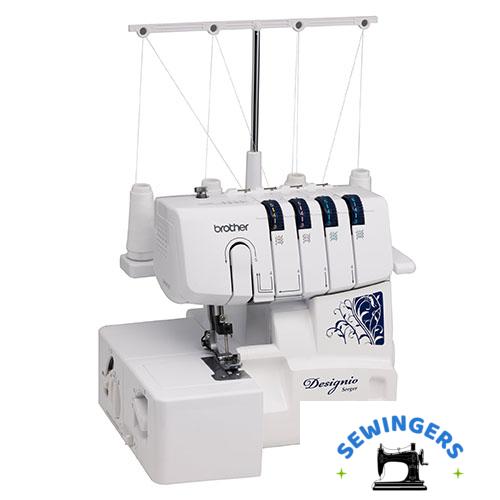
The Designio line from Brother occupies an interesting position — it’s genuinely affordable, but it doesn’t feel like it made sacrifices to get there. These machines are built for people who want professional results without paying professional-grade prices, and for the most part, they deliver.
Speed-wise, 1300 stitches per minute is legitimately fast. You can move through detailed fashion work at a pace that actually keeps up with how you’re thinking. Threading is color-coded, which sounds minor until you’ve fought with a poorly labeled machine and lost 30 minutes to it.
The differential feed is one of the standout features here. It handles knits and stretch fabrics with a ratio of 0.7–2.0, which means your stitches stay even on materials that other machines tend to distort. Combined with adjustable stitch widths, you get a lot of control over how the finished seam actually looks and feels.
You’ll also get a gathering foot, piping foot, and blind hem foot included — along with two starter threads. That’s enough to get into some genuinely creative territory right away. The removable free arm makes pant hems and sleeves much less awkward, and the front panel storage is a small thing that ends up mattering more than you’d think.
It handles linens, formal wear, and stretch fabrics well. LED lighting helps when you’re working with dark materials or in less-than-ideal conditions. Not the most glamorous feature, but useful more often than not.

Pros
- Works with standard machine needles for hems and edge finishing
- Sews 1,300 stitches per minute — a genuine time saver on larger projects
- Color-coded threading system makes setup much less stressful
- Convertible sewing surface supports free arm operations
- Easier access to awkward areas like sleeves and cuffs
- Detachable table area for serging round or circular pieces
- Differential feed ratio (0.7 to 2.0) keeps stitch quality consistent
- 23 built-in serger stitch functions
- Upper dial needle threading tension is comfortable to adjust
- Stitch length: 2mm–4mm; stitch width: 5mm–7mm
- 3/4 threads with 2 needles
- Screw-type presser foot pressure adjustment
- LED lighting for working in low-light conditions
- Solid value for the price point
Cons
- Doesn’t support decorative flatlock stitching
- Some users have experienced fabric snagging under the presser foot
- Not the best choice if you’re regularly working with very heavy fabrics
2. Janome 8002D Serger With Bonus Package

Janome has been around long enough to have earned a real reputation — not a marketing one. In the sewing world, they’re consistently mentioned when people talk about machines that just work reliably over years of use. Their accessories are well-regarded too, which isn’t always the case with big manufacturers.
The 8002D is designed around professional finishing. Threads, hems, fabric edges across a pretty wide material range — it handles all of it with the kind of consistency that makes your work actually look like you knew what you were doing. Compact build, but nothing about it feels cheap.
Switching between 3 and 4 thread operation is straightforward, and rolling hems just requires moving the needle plate to the “R” position. That’s the kind of design choice that saves real time when you’re mid-project and just want things to work.
At 1300 stitches per minute, it keeps pace with the Brother. The quiet operation is a genuine selling point if you’re working in a shared space or late at night. The extra-high presser foot lifter is useful for thicker fabrics that would otherwise require real effort to maneuver. Color-coded threading chart, included needles in two sizes, and a Janome Needle Threader round out a package that’s ready to go right out of the box.
Pros
- Good range of stitching options to choose from
- Solid number of serging functions for the price range
- Sturdy, compact, and precise construction
- Color-coded threading that’s actually easy to follow
- Most operations can be handled automatically — saves time
- 1300 stitches per minute keeps pace on larger jobs
- Handles both simple and thinner fabric types well
- Extra-high presser foot lifter for working with thicker materials
- Noticeably quieter than comparable machines in this range
- Comes with all the essential accessories included
- Several optional feet available with strong feature sets
Cons
- Threading design has room for improvement
- Missing a free arm feature, which some buyers found frustrating
- No automatic tension adjuster — you’ll manage that manually
3. Juki MO654DE Portable Thread Serger Sewing Machine

Juki isn’t flashy about its reputation, but in the serger and quilting space, people keep coming back to them. The emphasis on durability without inflating the price is consistent across their product line, and the MO654DE is a solid example of that.
What stands out with this model is the cutting system. It’s dedicated and powerful enough to make a noticeable difference in domestic use — stitch quality improves when the cutting mechanism is reliable, and that’s something you feel over time rather than on the first day.
Rolled hem capabilities are automatic. You’ve got 2/3/4 thread serging adjustment, color-coded threading, and a breakaway looper that makes the setup process a lot less fiddly. The differential feed and stitch length adjustments are positioned on the outside of the machine, which sounds like a minor thing but becomes very convenient when you’re switching between projects.
The knife can be finely adjusted for consistency across different project scales, and the upper knife design stays out of the way during threading — a smart safety consideration. A multipurpose foot expands what you can do with elastic, tapes, and varied stitch types.
There’s a micro safety switch in the side case that cuts the motor when the case is open. That detail matters more than it sounds like it should.
At 1500 stitches per minute, this one is faster than both the Brother and the Janome above. Good for exploring diverse design approaches and knitting patterns.
Pros
- Portable and relatively lightweight compared to similar machines
- Safety stitch disables automatically when the sewing cover opens
- Quiet and compact with solid seam-refining options
- Creates decorative bunched effects on necklines, sleeves, and skirts
- User-friendly design that most people pick up without much trouble
- 2/3/4 thread serging with automated rolled hem
- Handles a full range from delicate to heavy fabrics
- 1500 stitches per minute — genuinely fast
- Stitch length up to 4mm
- Differential feed ratio of 0.7 to 2.0
Cons
- Some users had difficulty maintaining consistent tension
- At least one customer reported looper issues and loopy needle stitches over time
4. Brother 2340CV Advanced Serger, White

Brother has built something of a track record in this space — not just with the machines themselves, but with what happens after you buy one. Their customer service is one of the less-discussed reasons people keep coming back to the brand.
The 2340CV is a cover stitch machine, which puts it in slightly different territory from the others on this list. With one looper and three needles, it opens up chain stitching, decorative applications, and the kind of precise professional hemming that’s difficult to replicate any other way. T-shirt stitching, in particular, is where this machine tends to get mentioned most by people who’ve used it seriously.
The technology inside supports decorative and creative work specifically — it’s not just a finishing machine. You’ve got tri-cover stitch capability, narrow and wide cover stitch options, and a looper threading setup that won’t have you pulling your hair out. Adjustment dials and color-coded threading are standard here.
Snap-on feet, differential feed, and a presser foot dial give you control over speed and stitch length per project — which matters when you’re moving between lightweight jersey and heavier knits. Those features are also what helps prevent the stretched, wavy look that plagues poorly fitted stitches.
The accessory bag is thorough: 4 thread nets, needle set, 4 spool caps, tweezers, cleaning brush, 4 spool mats, hexagonal wrench, operating manual. The 25-year limited warranty is notably generous.
Pros
- Solid overall serging experience
- Differential fabric feed improves stitch quality consistently
- Color-coded threading that’s easy to follow
- Prevents stretched and wavy stitch marks on fabric
- Comes with a complete accessory bag — tools included
- Presser foot dial, differential feet, and snap-on feet for flexible stitch length
- Includes a soft dust cover
- Backed by a 25-year limited warranty from Brother
- Strong choice for swimsuit strapping and dance costume construction
- Handles chain stitch finishes for belt loops and hems
- One looper and 3 needles for creative stitch variety
Cons
- Thread breakage reported by some users during sewing
- One reviewer felt the price was on the high side
- At least one defective unit reported — though Brother replaced it quickly
5. Juki Pearl Line MO-654DE Serger
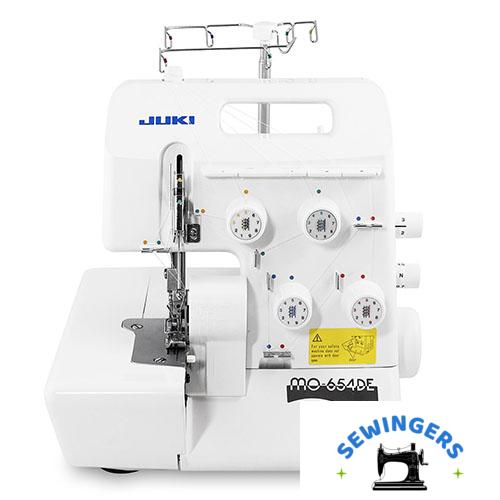
The MO-654DE from Juki’s Pearl Line is the most accessory-rich option on this list, and the performance backs up what’s in the box. Ease of use, durability, and consistent results across fabric types — it covers a lot of ground without feeling overwhelming.
What makes this machine particularly interesting is the stitch variety. You’re working with: 2-thread overcast, 2-thread rolled hem, 3-thread flatlock, 3-thread overlock, 3-thread rolled hem, 3-thread narrow overlock (4mm), and 4-thread overlock. That’s a meaningful range, not just numbers on a spec sheet.
Threading is color-coded and ties directly into consistent thread tension — the two work together in a way that produces more predictable results than machines where tension is handled separately. The upper and lower knife system is built for longevity; it handles thickness variation without wearing unevenly over time.
LED lighting is included, which matters when you’re working on dark fabrics or late in the day. Speed tops out at 1500 stitches per minute — same as the portable Juki above. The micro safety switch is the same design too: machine won’t run with the swing cover open.
The “ALL I WANT PACKAGE” is the real differentiator here. It includes the serger itself, an electronic workbook CD, instructional DVD, 50 needles, an 8-foot kit, 8 cones of Maxilock thread, and a serger tote bag. Standard accessories cover basically everything: screwdrivers, spool caps, presser foot, thread nets, needle pack, vinyl cover, tweezers, power cord, foot control, accessory pouch, spare lower knife, oiler, brush, needle inserter, needle threader, light bulb, 2/3 thread selector, guide bar, and instruction manual.
It’s a lot. For someone who wants to start without sourcing accessories separately, that has real practical value.
Pros
- Impressive stitch quality across fabric types
- Durable and adjustable — handles complex projects reliably
- Snap-on presser feet for professional finishing with flexible options
- Sewing gauge helps keep seams accurate and consistent
- Micro safety switch protects fingers during operation
- Threading experience is comfortable and well-designed
- Disengaging looper and snap-on presser feet included
- Adds a clean, polished finish to whatever you’re stitching
- 2/3/4 threading options reduce threading complexity
- The “I WANT IT ALL” bonus package is genuinely comprehensive
Cons
- Users with vision problems may find the machine difficult to use
- Priced higher than some comparable options
- Some of the included instructional videos have audio issues
Wrapping Up
The Brother Designio Series DZ1234 holds up well as a practical choice — particularly if you’re looking for something that balances everyday usability with results that actually look professional. The included feet and starter threads mean you’re not assembling things from scratch before you can start.
At 1,300 stitches per minute, it keeps up with most project paces without feeling rushed. And the fabric range — knits, stretch materials, linens, formal wear — is wide enough that it won’t limit you as your projects evolve.
For the price, the performance is genuinely hard to argue with. Whether you’re just getting started or you’ve been sewing long enough to know exactly what you want, it’s a machine worth considering seriously.