If you’ve ever sat down to sew and noticed that your machine sounded a little rougher than usual, that tiny change often points to a bigger issue developing beneath the surface.
A sewing machine is a precision tool. Every time you press the foot pedal, dozens of internal parts move together at remarkable speed. The needle bar travels up and down, the rotary hook catches thread loops, the feed dogs advance fabric, and the drive shaft keeps everything synchronized. It’s an impressive mechanical dance.
What keeps that movement smooth is lubrication.
Without proper oiling, friction increases. Heat builds. Components wear faster. Stitch quality gradually declines. The process is slow enough that many sewists don’t notice it until performance drops or repairs become necessary.
Whether you sew quilts during the holiday season, alter garments for clients, or run a home-based Etsy business, regular oiling protects both performance and longevity. In today’s sewing landscape, where machines from Singer, Brother, Janome, Bernina, and Juki represent significant investments, maintenance matters.
Contents
- 1 Why Do You Need to Oil Your Sewing Machine for Mechanical Integrity?
- 2 How Lubrication Reduces Friction and Heat
- 3 Why Do You Need to Oil Your Sewing Machine to Prevent Costly Repairs?
- 4 Impact on Stitch Quality and Fabric Performance
- 5 Types of Sewing Machine Oil: What Should You Use?
- 6 How Often Should You Oil Your Sewing Machine?
- 7 Signs Your Sewing Machine Needs Oil
- 8 Step-by-Step Best Practices for Proper Oiling
- 9 Why Do You Need to Oil Your Sewing Machine Even If It’s Working Fine?
- 10 Advanced Maintenance Considerations for Professionals
- 11 Final Thoughts: Why Do You Need to Oil Your Sewing Machine?
Why Do You Need to Oil Your Sewing Machine for Mechanical Integrity?
Every sewing machine depends on moving assemblies working within precise mechanical tolerances.
Inside the machine, components such as the rotary hook, bobbin case, drive shaft, needle bar, and feed dogs operate thousands of times per minute. At that speed, even microscopic friction creates wear.
The underlying principle is simple: metal rubbing against metal causes abrasion.
Oil creates a protective barrier between surfaces. Without that barrier, tiny scratches begin forming on internal parts. Those scratches might seem insignificant at first, but they gradually alter wear patterns and reduce accuracy.
Several mechanical factors come into play:
- Friction coefficient
- Heat transfer
- Metal fatigue
- Mechanical tolerance
- Surface wear patterns
Over time, insufficient lubrication can affect machine timing. When timing drifts, stitches become inconsistent and repairs become more likely.
Across many U.S. repair shops, timing adjustments and worn hook assemblies commonly fall into the $100 to $300 range, depending on labor costs and machine complexity. A few drops of oil cost far less.
Think of lubrication as preventive insurance for your machine’s moving parts. The damage doesn’t happen overnight. It accumulates quietly.
How Lubrication Reduces Friction and Heat
Oil performs one job exceptionally well: it separates moving metal surfaces.
Instead of direct contact, a thin lubricating film absorbs friction and reduces resistance. As a result, the machine operates more efficiently.
The benefits show up in several ways:
- Smoother stitch formation
- Reduced motor strain
- Lower electrical load
- Extended motor lifespan
- Quieter operation
Now, here’s the interesting part.
Heat is often the hidden enemy. When lubrication breaks down, friction converts directly into heat. Increased temperatures cause thermal expansion, which can affect precise mechanical alignment.
Machines with tight engineering tolerances, such as Bernina 700 Series models, are particularly sensitive to friction-related changes. Even minor increases in resistance can influence stitch consistency.
In warmer regions such as Texas, Florida, Arizona, and parts of the Southeast, ambient temperatures add another layer of stress. Internal heat buildup occurs faster, making lubrication even more valuable during extended sewing sessions.
Why Do You Need to Oil Your Sewing Machine to Prevent Costly Repairs?
Repair technicians frequently identify dried grease, lint accumulation, and inadequate lubrication as leading causes of sewing machine problems.
Neglected machines often require:
- Hook replacement
- Motor servicing
- Timing recalibration
- Belt replacement
- Bearing maintenance
The financial difference is substantial.
| Maintenance Item | Typical Cost (USD) | Commentary |
|---|---|---|
| Annual sewing machine oil | Under $10 | A small expense that supports long-term performance. |
| Basic cleaning and lubrication | $50–$100 | Helpful when maintenance has been delayed. |
| Timing adjustment | $100–$300 | Often necessary after prolonged wear affects synchronization. |
| Hook assembly replacement | $150–$400+ | Costs rise quickly on premium machines. |
| Motor repair or replacement | $200–$500+ | One of the more expensive outcomes of neglected maintenance. |
The contrast is difficult to ignore. A few minutes spent oiling periodically can help avoid repairs that cost twenty or thirty times more.
Beyond repair costs, maintenance also protects warranty compliance, resale value, and productivity. For anyone relying on sewing income, downtime can be more expensive than the repair itself.
Impact on Stitch Quality and Fabric Performance
Lubrication affects more than mechanical health.
It directly influences stitch quality.
When internal components move smoothly, thread paths remain consistent and loop formation occurs exactly as intended. When friction increases, stitch problems begin appearing in ways that often seem unrelated to lubrication.
Common symptoms include:
- Skipped stitches
- Thread breakage
- Uneven tension
- Fabric puckering
- Inconsistent stitch length
Advanced techniques reveal these issues even faster.
Free-motion quilting, machine embroidery, decorative stitching, and precision garment construction all depend on consistent mechanical rhythm. A dry rotary hook can disrupt thread loop formation enough to affect the finished result.
Several interconnected components rely on smooth operation:
- Upper thread tension discs
- Presser foot pressure system
- Stitch regulator
- Take-up lever
- Bobbin tension spring
Clean motion creates clean stitches.
That’s the practical reality many sewists eventually discover after troubleshooting thread issues that weren’t actually thread-related at all.
Types of Sewing Machine Oil: What Should You Use?
Not all oils belong inside a sewing machine.
In practice, only clear, lightweight sewing machine oil designed specifically for textile equipment delivers the correct balance of lubrication and cleanliness.
Look for these characteristics:
- Non-detergent formulation
- Low viscosity
- Resin-free composition
- Non-staining properties
- Heat stability
Several widely available products in the U.S. market include:
- Singer All-Purpose Machine Oil
- Zoom-Spout Sewing Machine Oil
- Dritz Sewing Machine Oil
Just as important is knowing what to avoid.
Avoid:
- WD-40
- Cooking oils
- Automotive oils
- Household lubricants
These products can attract dust, create residue, damage seals, or interfere with internal mechanisms.
A sewing machine contains delicate precision parts. Using the correct lubricant protects that precision.
How Often Should You Oil Your Sewing Machine?
Oiling frequency depends largely on how often the machine is used.
| Usage Level | Recommended Oiling Frequency |
|---|---|
| Occasional hobbyist | Every 3–6 months |
| Weekly sewing | Monthly |
| Daily professional use | Weekly |
These guidelines provide a useful starting point, although individual machines vary.
If you’re preparing for a busy sewing season—Halloween costumes, Thanksgiving table runners, Christmas gifts, graduation projects, or wedding alterations—a fresh cleaning and oiling session beforehand often improves reliability during periods of heavy use.
Many modern machines also feature self-lubricating systems. In those cases, the owner’s manual remains the most reliable source of guidance.
Signs Your Sewing Machine Needs Oil
Machines rarely fail without warning.
Most provide subtle clues first.
Pay attention to:
- Grinding noises
- Sluggish handwheel movement
- Burning smells
- Increased vibration
- Visible metal dust
- Reduced sewing speed
- Irregular stitch formation
Noise changes are often the earliest indicator.
A healthy sewing machine tends to sound smooth and consistent. When lubrication diminishes, the sound becomes harsher, rougher, or slightly strained. The difference can be surprisingly noticeable once you know what to listen for.
Small changes matter because they usually appear before significant damage develops.
Step-by-Step Best Practices for Proper Oiling
Proper oiling is straightforward and takes only a few minutes.
Step 1: Unplug the Machine
Safety comes first. Disconnect power before opening access panels or removing components.
Step 2: Remove the Needle Plate and Bobbin Case
These areas collect the majority of lint and thread debris.
Step 3: Clean Thoroughly
Use a nylon cleaning brush to remove lint buildup.
Keep these tools nearby:
- Lint brush
- Microfiber cloth
- Small screwdriver
- Tweezers
- Scrap muslin or cotton fabric
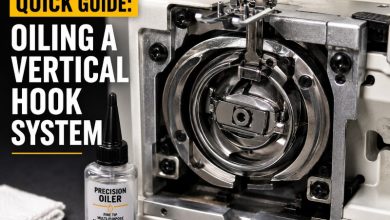
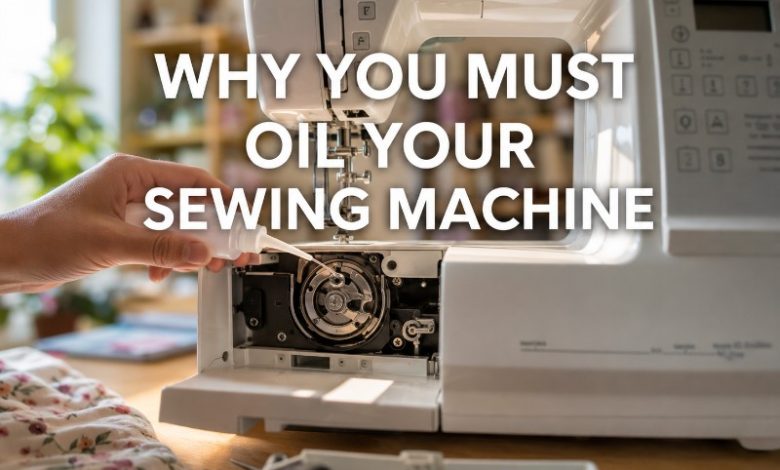
Step 4: Apply Oil
Place one or two drops of sewing machine oil at designated lubrication points identified in the owner’s manual.
Less is usually better.
Step 5: Rotate the Handwheel
Turn the handwheel manually to distribute oil throughout the moving components.
Step 6: Test on Scrap Fabric
Run the machine briefly on scrap cotton or muslin before returning to a project.
This step removes excess oil and prevents accidental fabric staining.
Why Do You Need to Oil Your Sewing Machine Even If It’s Working Fine?
This is where many maintenance routines break down.
A machine can appear to work normally while wear is slowly accumulating inside.
Mechanical deterioration happens gradually. Problems become visible only after enough damage has developed to affect performance.
Preventive lubrication helps:
- Extend lifespan beyond 10–20 years
- Maintain factory timing
- Preserve stitch calibration
- Support motor efficiency
- Reduce long-term wear
Vintage Singer machines provide a perfect example. Many models manufactured decades ago continue sewing today because owners maintained consistent lubrication schedules throughout their lifespan.
Working fine and working optimally aren’t always the same thing.
Advanced Maintenance Considerations for Professionals
Professional sewists and high-volume users benefit from a broader maintenance strategy.
Additional considerations include:
- Annual servicing by certified technicians
- Drive belt inspections
- Timing verification
- Carbon motor brush monitoring
- Humidity management
Humidity deserves special attention.
In coastal and humid regions, oxidation develops more readily on exposed metal surfaces. A thin film of oil helps protect against corrosion while supporting smooth operation.
Maintenance logs are also valuable in professional settings. Recording service dates, cleaning intervals, and lubrication schedules creates consistency and helps identify patterns before problems become expensive.
Final Thoughts: Why Do You Need to Oil Your Sewing Machine?
You need to oil your sewing machine because lubrication protects precision, reduces friction, prevents costly repairs, and preserves stitch quality.
Every stitch depends on coordinated movement among dozens of mechanical parts. Oil keeps those parts moving smoothly while minimizing wear and heat.
The benefits are practical and measurable:
- Longer machine lifespan
- Better stitch consistency
- Lower repair costs
- Improved motor efficiency
- Greater reliability during demanding projects
A sewing machine represents more than a tool. It supports creativity, craftsmanship, and often income. Routine lubrication protects that investment while helping every project run more smoothly.
The result is simple: better performance today and a machine that’s still ready to sew years from now.