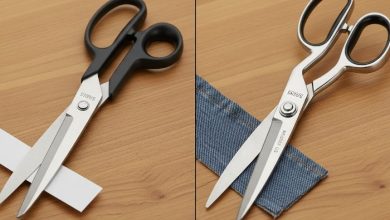
You probably don’t think about scissors all that often. Most folks don’t—until they stop working right. Then suddenly you’re staring down at them like, What even are you? I get it. On the surface, scissors are the ultimate “everyday tool”—they sit quietly in your junk drawer or your sewing kit until needed. But if you’ve ever actually used a pair that just felt “off,” you’ve already noticed the gap between a good pair and a great one.
I’ve spent over a decade working with scissors—reviewing, testing, breaking, fixing, and writing about them for sewingers.com. Whether you’re snipping silk, trimming a wick, or opening stubborn packaging, there’s more happening in that mechanism than you might guess.
Let’s break down the three most critical parts of a scissor—the blades, the handles, and the pivot—and why understanding them changes everything about how they cut, feel, and last.
Contents
What Makes Up a Scissor? (Key Takeaways First)
Here’s the short version—because sometimes you just want the “what matters” stuff up front:
- Every scissor is built around three main components: the blades, the handles, and the pivot mechanism.
- Blade design impacts everything from how sharp they are to what materials they can handle.
- Handle shape and grip materials determine whether your hands love or hate you after 10 minutes of cutting.
- The pivot is the engine room—it distributes pressure and creates that cutting action we take for granted.
- American companies like Fiskars and Westcott have seriously upped the game when it comes to ergonomic design.
- Materials matter—stainless steel vs. carbon steel isn’t just a durability issue; it changes your sharpening schedule, too.
- Scissors are not one-size-fits-all. Sewing, kitchen, barber, and utility scissors are built with totally different specs for a reason.
- Maintenance is not optional—proper care extends lifespan and cutting performance (I’ve seen $5 scissors outlast $25 ones just because of regular oiling).
A Brief History of Scissors in America
Let me start with something most people don’t realize: Thomas Jefferson carried scissors with him. Like, literally kept them close. That tells you two things—1) scissors have been around a long time, and 2) even the Founding Fathers understood their practical value.
The earliest American scissors came from Europe, but things really picked up during the Industrial Revolution, when manufacturing scaled and patents for scissor improvements started rolling out. By the 20th century, scissors had become a staple in nearly every U.S. household.
Fiskars, originally Finnish, made a big splash when they brought their signature orange-handled scissors to the U.S. in the 1960s. And Westcott, based in Connecticut, became a household name through schools, offices, and crafting. These brands didn’t just mass-produce scissors—they iterated on them, offering ergonomic grips, specialty edges, and ambidextrous designs that are still unmatched in many respects.
Related post: 10 Best Sewing Scissors and Shears Reviewed & Rated
Anatomy Breakdown: Understanding the Blades
This is where most people start to feel the difference—even if they don’t know what they’re feeling.
In practice, blades aren’t just sharp or dull—there’s a whole geometry at play:
- Straight edge vs. micro-serrated blades – Straight blades slice cleanly (great for fabric), while serrated edges grip the material (great for slippery stuff like ribbon or plastic).
- Blade tip shape – A pointed tip allows precision (like in embroidery scissors), while a blunt tip is safer for things like kids’ scissors or trauma shears.
- Steel hardness – Measured on the Rockwell scale, harder blades stay sharp longer, but can chip more easily. Most consumer scissors fall between HRC 55–60.
- Material type –
- Stainless steel resists rust and is low-maintenance.
- Carbon steel is sharper and tougher, but it’ll rust if you leave it damp. I learned that the hard way with my first pair of tailor shears.
What I’ve found: Carbon steel cuts like a dream, but only if you’re willing to oil it once in a while. If you’re lazy about maintenance (hey, no shame), stick with stainless.
The Role of Handles in Comfort and Control
I didn’t care about handle design—until I started getting that weird thumb cramp from long sewing sessions. Turns out, handles matter more than most people think.
There are a few things to pay attention to:
- Ergonomic vs. symmetrical designs – Ergonomic handles cradle your fingers in a way that reduces fatigue. Symmetrical handles are more universal but can be harder on your grip over time.
- Left-handed compatibility – Most scissors are made for righties, even if the packaging says “ambidextrous.” If you’re left-handed, you’ll want true lefty scissors, where the blades are reversed to give a clean line of sight.
- Grip materials – You’ll see a lot of ABS plastic mixed with rubberized coatings these days. These “comfort grips” are easier on the fingers and help prevent slippage.
In my experience: If you’re doing detail work—like embroidery or cutting intricate patterns—soft grips and finger rests are game-changers.
The Pivot: Heart of the Scissor Mechanism
You don’t see the pivot doing much, but it’s doing everything.
That little screw or rivet in the center? That’s where all the magic (and mechanical leverage) happens. When that joint’s off—even slightly—the scissor either drags, bites unevenly, or won’t cut at all.
Here’s what matters:
- Rivets vs. screws – Rivets are fixed; once they wear down, you can’t tighten them. Tension screws, on the other hand, can be adjusted as the scissors age.
- Friction balance – If the pivot is too tight, you’ll feel resistance. Too loose? The blades won’t stay aligned.
- Maintenance – I usually add a drop of mineral oil every few months. You can use sewing machine oil too—just make sure to wipe off the excess.
What I watch for: If the blades start making a grinding sound or feel “loose,” I check the tension before blaming the blades. Nine times out of ten, it’s the pivot.
Final Thoughts (But Not Really “Final”)
If you’ve read this far, you’re probably like me: someone who wants tools that work with you, not against you.
What I’ve learned after years of working with scissors—testing, tweaking, sometimes breaking them—is that they’re not “just” scissors. They’re precision tools that rely on thoughtful design, reliable materials, and a mechanical harmony between their parts.
So the next time you pick up a pair—whether it’s a $6 utility model or a $70 tailor’s pair—you’ll know where to look, what to feel for, and why even the smallest detail can change everything about how they work.
And yeah, I still keep a pair of backup Fiskars in my junk drawer. Old habits.