


You know what they don’t tell you when you start working with leather? It’s not just about power. It’s about personality.
Sure, leather demands muscle — thick layers, stubborn grain, sometimes slick, sometimes stretchy — but you also need a machine that matches your energy. If you’re someone who designs with flair, sews with conviction, and wouldn’t be caught dead using a dull, clunky workhorse with zero soul… you’re not alone. And no, this isn’t your grandma’s sewing machine list. This one? This one’s for the bold.
Now, whether you’re sewing structured handbags or making leather fringe jackets that scream confidence, your machine needs to keep up. Not just in brute strength — like heavy-duty motors and consistent needle penetration — but in how it feels when you’re working. You want smooth stitch precision, responsive speed control, and the right amount of presser foot pressure to glide over thick seams without hesitation.
So let’s get into it. This guide walks you through the best leather sewing machines for creative souls like yours — the ones that show up to the studio with a little swagger.
Contents
- 1 What Makes a Leather Sewing Machine Sassy?
- 2 5 Top-Rated Sewing Machine For Leather With Reviews
- 2.1 1. Janome HD3000 Heavy Duty Sewing Machine
- 2.2 What stands out:
- 2.3 Pros:
- 2.4 Cons:
- 2.5 My verdict:
- 2.6 What’s inside:
- 2.7 Pros:
- 2.8 Cons:
- 2.9 My verdict:
- 2.10 3. EverSewn Maker 100 Mechanical Sewing Machine
- 2.11 What I like:
- 2.12 Pros:
- 2.13 Cons:
- 2.14 My verdict:
- 2.15 4. SINGER SEW MATE 5400 Handy Sewing Machine
- 2.16 What it brings:
- 2.17 Pros:
- 2.18 Cons:
- 2.19 My verdict:
- 2.20 5. Juki TL-2010Q Portable Sewing Machine
- 2.21 What’s under the hood:
- 2.22 Pros:
- 2.23 Cons:
- 2.24 My verdict:
- 3 Leather Sewing Machine Comparison Table
- 4 How to Choose the Best Leather Sewing Machine for Your Needs
- 5 Consider Your Leather: Type and Thickness Matter More Than You Think
- 6 Match the Machine to the Project Type
- 7 Frequency & Scale of Your Work
- 8 Think About Your Workspace
- 9 Watch for Thread and Needle Compatibility
- 10 Summary: Match the Machine to Your Needs, Not Just the Hype
What Makes a Leather Sewing Machine Sassy?
I’ve tested machines that were technically “good” — but good isn’t enough when you’re pouring your creativity into leather. Sassy means the machine works with you, not just for you. Think strength with style.
It’s in the design — matte black casing, punchy button colors, sleek dials that don’t feel like relics from 1984. It’s in the user experience too: machines with intuitive user interfaces, clear feature sets, and tactile controls you can operate mid-project without pausing to squint.
Here’s what tends to define a truly sassy machine:
- Confident stitch strength that doesn’t flinch at 3+ layers of leather
- Machine aesthetics that match your vibe (yes, this matters more than people admit)
- A solid frame, but not brick-heavy (because most of us do move our machines)
- Accessory compatibility — Teflon feet, roller feet, leather-specific needles, the works
- User-friendly knobs or dials you can tweak mid-stitch without breaking rhythm
It’s the sewing equivalent of wearing steel-toe boots that also have rhinestones on them
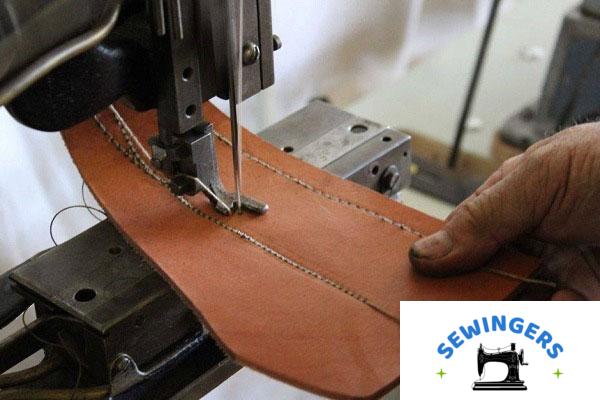
5 Top-Rated Sewing Machine For Leather With Reviews
1. Janome HD3000 Heavy Duty Sewing Machine


The Janome HD3000 is one of those machines that doesn’t try to impress you with flash—it just works. You know that feeling when you sew through thick leather and expect resistance, but the machine just hums right through it? That’s the HD3000 in action.
What stands out:
- Stitch strength over stitch count – You get 18 built-in stitches, but honestly, I’ve only ever used 4 on leather. What matters here is consistency.
- Stitch length control is smooth and responsive—important when you’re switching between 3oz and 8oz leather.
- Metal interior frame keeps it from shaking or “walking” across your table at high speeds.
- Built-in needle threader—minor luxury, but I’ll admit, once I had it, I never wanted to go back.
- Presser foot pressure adjustment helps prevent that awful leather drag.
Pros:
- Motor strength is legit – It punches through two layers of belt leather without groaning.
- Mechanical reliability – Nothing computerized to glitch out mid-project.
- Easy tension dial – It’s not sensitive to every tiny twist like some older mechanicals.
Cons:
- No speed control – You get one speed: fast. If you’re a nervous foot, it takes practice.
- A little noisy – Not industrial loud, but not whisper quiet either.
My verdict:
The HD3000 is a workhorse. It’s not fancy, but if you need a leather crafting machine that just handles thick material with no drama, this is it. Honestly, it’s the machine I recommend most to people starting to get serious with leather.

You don’t need to drop half a paycheck to start sewing leather—especially if you’re still figuring out if you like leatherwork. That’s where the Brother ST371HD shines.
Now, I’ll be upfront: this isn’t a pro’s forever machine. But for beginners or hobbyists dabbling in wallets, patches, or lighter leather goods? It punches above its weight.
What’s inside:
- Leather needle set included – Huge plus. You won’t believe how many machines don’t come with compatible needles.
- Non-stick foot included for vinyl and soft leather.
- Feed system isn’t industrial, but it’s solid for entry-level work.
- Bobbin winder and top drop-in setup makes threading frustration-free.
Pros:
- Super affordable – Often under $200.
- Strong motor for its size – Handles up to 6oz leather if you’re patient.
- Lightweight and compact – You can lug it to classes or stash it in a closet.
Cons:
- Limited presser foot pressure control – Can cause uneven stitching on thicker hides.
- Not ideal for long seams or multi-layered projects.
My verdict:
If you’re a beginner or weekend hobbyist, the ST371HD is a smart first step into leather. I wouldn’t use it for saddlebags or armor (yep, I’ve had that request), but it’s great for wallets, labels, or trim work. Think of it as your “training wheels” leather machine.
3. EverSewn Maker 100 Mechanical Sewing Machine

This one surprised me. The EverSewn Maker 100 doesn’t scream “leather machine,” but in a small studio setup, it pulls its weight—literally and figuratively. I first used it while house-sitting for a friend who works with soft garment leathers, and I remember thinking: Wait, this little guy can do that?
What I like:
- Gear-driven mechanical build gives it nice torque for light to midweight leather.
- Snap-on presser feet—convenient when switching between walking foot and standard.
- Compact design makes it easy to fit on crowded work surfaces.
- Stitch selector dial keeps things clean and mechanical—less chance for digital weirdness.
Pros:
- Lightweight (around 13 lbs)—easy to move and store.
- Smooth tension control – Especially helpful for thinner chrome-tanned hides.
- Quiet operation – You won’t wake the house at midnight.
Cons:
- Not built for big hides or stacked seams.
- No extension table – so you’re working in tight space unless you DIY a fix.
My verdict:
If you’re sewing in a small space or need a machine for quick, lightweight leather work, the Maker 100 earns its keep. I wouldn’t use it for bridle leather, but garment leather? Faux? You’re good.
4. SINGER SEW MATE 5400 Handy Sewing Machine

This machine’s a bit of a wild card. The SINGER SEW MATE 5400 isn’t exactly built for leather—but with the right needle and settings, you can get clean, decorative stitches that pop on softer leathers.
What drew me in? The digital stitch selection and the surprisingly responsive speed control via foot pedal. It lets you ease into curves and slow down on corners—a lifesaver when you’re doing patchwork or embroidery on leather.
What it brings:
- 60 stitch types (yes, sixty)—more than you’ll likely use, but great for embellishments.
- LED-lit screen makes stitch adjustments feel less guesswork-y.
- Built-in thread cutter – tiny convenience, big time-saver.
- Buttonhole options for custom projects (think: leather-bound journals).
Pros:
- Electronic controls are intuitive even for analog-loving folks like me.
- Great for decorative work on soft leathers—embellished bags, patches, etc.
- Affordable for a computerized model.
Cons:
- Struggles with thick veg-tan or dense suede—this is not a workhorse.
- Plastic frame—so no heavy-duty punch-through.
My verdict:
I’d say the 5400 is for creatives who want some fun built-in, not leathercrafters who need brute force. It’s great for experimenting, but not for belt-making or saddlery.
5. Juki TL-2010Q Portable Sewing Machine

Okay, this one? It’s my go-to for serious leatherwork. The Juki TL-2010Q doesn’t mess around. It’s technically marketed as a quilting machine, but don’t let that fool you—it has semi-industrial muscle, and you feel it from the first press of the foot pedal.
I’ve sewn 8 layers of waxed canvas with leather accents on this beast and it didn’t blink.
What’s under the hood:
- Aluminum frame – minimal vibration, excellent stability.
- Straight stitch only – but it does that one thing extremely well.
- High-speed motor—1500 stitches per minute if you want it.
- Needle up/down control for precision pivoting.
- Knee lifter and extension table? Yes, please.
Pros:
- Thread trimming button—I didn’t think I’d care. I was wrong.
- Speed control slider—helps when you’re doing tight corners or edge stitching.
- Built for pros, feels like it.
Cons:
- Pricey – usually $800–$1,000.
- One stitch only – no zigzag, no fun extras.
My verdict:
If you’re a leather pro or serious hobbyist making bags, boots, or even holsters, the TL-2010Q is worth every penny. It’s fast, clean, and trustworthy. Just know—it’s not for beginners. It expects you to keep up.
Leather Sewing Machine Comparison Table
| Machine | Best For | Stitch Options | Power Level | Portability | My Take |
|---|---|---|---|---|---|
| Janome HD3000 | Thick leather projects | 18 | High | Medium | Best all-rounder for daily use |
| Brother ST371HD | Beginners, light leather | 37 | Moderate | High | Great entry point without overspending |
| EverSewn Maker 100 | Compact leather sewing | 21 | Moderate | Very High | Ideal for studio work or soft leather |
| SINGER SEW MATE 5400 | Decorative soft leather | 60 | Low-Med | Medium | Creative extras, not a workhorse |
| Juki TL-2010Q | Pro-level heavy leather | 1 (straight) | Very High | Medium | Industrial feel in a portable package |
How to Choose the Best Leather Sewing Machine for Your Needs
You ever try sewing 6oz veg-tan leather on a home machine and hear that awful whrrr-chunk sound? The one where you just know the needle bent, the thread tangled, and your tension’s gone on vacation?
Yeah—that sound is why this part matters.
Choosing the best sewing machine for leather isn’t just about horsepower. It’s about understanding your workflow, your materials, and what you actually plan to sew day after day. Because a machine that’s perfect for custom belts might be a total pain if you’re sewing upcycled leather jackets with delicate linings.
So before you hit that “Buy Now” button, let’s talk about what really makes a machine right for you.
Consider Your Leather: Type and Thickness Matter More Than You Think
Not all leather is created equal—and your machine has to match the mood.
- Garment leathers (like lambskin or chrome-tanned goat)? You’ll want a machine with finesse, not just force. Think fine-tuned tension accuracy and low foot pressure so you don’t end up stretching the hide out of shape.
- Tooling or bridle leather (4oz–8oz veg-tan)? Now you’re in heavy-duty territory. That means torque, feed strength, and serious needle penetration.
I’ve used the wrong machine more times than I care to admit—thinking “Well, it should be able to handle 3 layers…” It never ends well.
What I’ve found is that most people underestimate how fast leather thickness stacks up once you add seams, linings, or edge folds. That’s when your presser foot pressure, needle flex, and feed dog grip either shine—or betray you.
Match the Machine to the Project Type
Let’s say you’re mostly making wallets and soft accessories. You’re better off with a lightweight mechanical machine that handles precision over bulk. But if you’re building totes, belts, or upholstery, you’re going to need something that wants to be pushed.
Here’s how I break it down in my own studio:
| Project Type | Machine Priorities |
|---|---|
| Fashion/Apparel | Variable stitch length, lighter feed, smooth tension |
| Bags & Belts | High torque motor, walking foot compatibility, steel frame |
| Upholstery | Straight stitch speed, wide workspace, foot lift height |
| Hobby/Crafts | Flexibility, ease of use, quiet motor, accessory range |
If you’re doing a bit of everything, go for a machine that’s overbuilt for your hardest project. You’ll thank yourself later when it doesn’t stall mid-seam.
Frequency & Scale of Your Work
Here’s the truth no one tells you until you learn it the hard way: Machines that are “good enough” for occasional use rarely hold up when you’re sewing every weekend.
If you sew:
- Occasionally → Prioritize ease of setup, lower weight, and intuitive controls.
- Weekly or professionally → You’ll want a semi-industrial or heavy-duty model, one that stays consistent under pressure. Literally.
I burned out the motor on my first “heavy-duty” machine in under a year because I was running it like an industrial without realizing its limits. So think ahead. Ask yourself, “Will this machine still make sense when I’m three projects deep and halfway through a custom bag?”
Think About Your Workspace
Sounds minor, but it matters. Some machines look compact in photos—then you realize they need an extension table, a power stabilizer, and enough space behind the needle to actually rotate your work.
Quick checklist:
- Is your workspace permanent or portable?
- Do you have room for a flat-bed vs cylinder arm?
- Can your table handle the machine’s weight (some top out over 35 lbs)?
- Are you sitting at the right height to control the foot pedal without slouching?
You’d be surprised how many people forget this—and end up with back pain, dropped stitches, or a machine that simply won’t fit on their desk.
Watch for Thread and Needle Compatibility
Now, here’s where it gets nerdy—but important.
Your machine needs to be compatible with thicker thread weights (like bonded nylon or polyester) and leather-grade needles (typically size 16–22). If your bobbin system chokes on thick thread, or your needle plate can’t handle a wider shank, you’re going to have skipped stitches, tangled threads, and plenty of curse words.
Pro tip from the trenches: Always check if the bobbin case is adjustable for tension. That alone can save you hours of fiddling.
Summary: Match the Machine to Your Needs, Not Just the Hype
There’s no perfect machine for everyone. What works for me in a leather bag-making studio might drive you nuts if you’re just hemming leather pants once a month.
So here’s a short decision guide you can work from:
Top Factors to Weigh:
- Leather thickness & grade – Thicker = more motor + feed strength.
- Your typical project type – Bags vs garments = very different needs.
- How often you sew – Occasional use = lighter machine; daily = heavier build.
- Workspace limitations – Don’t overlook table size, power needs, and weight.
- Thread & needle compatibility – If it can’t handle leather-grade needles and thick thread, it’s not built for leather.


